The Evolution of Morna Music: Cape Verde’s Global Soul
On a humid evening in a small tavern in Mindelo, the air is thick with the scent of grogue and the melancholic vibration of a cavaquinho. A singer closes her eyes, pouring her soul into a slow, rhythmic melody that speaks of longing, the sea, and the bittersweet pain of departure. This is Morna—the heartbeat of Cape Verde. Once a localized folk tradition, Morna has evolved over centuries to become a UNESCO-recognized piece of Intangible Cultural Heritage, serving as the ultimate symbol of Cape Verdean identity on the global stage.
The Origins: A Fusion of Three Continents
The exact origins of Morna remain a subject of passionate debate among ethnomusicologists, but it is generally agreed that the genre emerged in the late 18th or early 19th century. Its birthplace is often pinpointed to the island of Boa Vista, though it reached its sophisticated artistic maturity on the island of São Vicente.
Morna is a “creole” genre in the truest sense of the word. It represents a sublime fusion of African rhythms, European melodic structures (specifically the Portuguese Fado), and perhaps even influences from the Modinha of Brazil. Historically, the lyrics were written in Cape Verdean Creole (Kriolu), providing a medium for the islands’ poets to express the collective psyche of a people shaped by isolation and the vast Atlantic Ocean.
The Soul of the Music: Sodade
To understand the evolution of Morna, one must understand the concept of Sodade (the Creole equivalent of the Portuguese Saudade). It is a complex emotion—a mixture of nostalgia, longing, regret, and tenderness for someone or something that has been lost. Because Cape Verde is an archipelago defined by emigration, Morna became the vessel for the “poetics of departure.”
The classic Morna is typically played in a minor key with a slow tempo. Traditional instrumentation includes the guitar (violão), the cavaquinho (a small four-stringed instrument), the violin, and often a piano or clarinet. The lyrics often touch on themes of the sea, the love for the motherland, and the “long road” to a life abroad.
Eugénio Tavares and the Literary Expansion
In the early 20th century, Morna underwent a significant stylistic shift, moving from a simple folk dance to a sophisticated literary form. This transformation is largely credited to Eugénio Tavares, a poet and musician from the island of Brava. Tavares elevated the lyrics to high poetry, focusing on romantic love and the beauty of the islands.
Later, in Mindelo, B. Léza (Francisco Xavier da Cruz) introduced “passing chords” influenced by Brazilian music, giving Morna a more complex harmonic structure. These innovations allowed the genre to transition from the dusty streets of the rural islands to the salons and radio stations of the growing urban centers.
The Cesária Évora Phenomenon: Internationalization
For most of the 20th century, Morna was a hidden gem, known only to Cape Verdeans and small circles in Portugal and the Netherlands. That changed in the late 1980s with the rise of Cesária Évora, the “Barefoot Diva.”
Évora’s journey from the bars of Mindelo to the world’s most prestigious stages (such as the Olympia in Paris and Carnegie Hall in New York) is legendary. Her 1992 album Miss Perfumado sold hundreds of thousands of copies, proving that music doesn’t need to be in English to touch the global heart. With her gravelly, emotive voice, she became the global ambassador for Morna, putting Cape Verde on the map for international music lovers and travelers alike.
Through Cesária, Morna was no longer just local folklore; it became “World Music”—a category that allowed Cape Verdean artists to access international distribution, festival circuits, and Grammy nominations.
Modern Evolution: Synthesizers and Orchestration
As the Cape Verdean diaspora grew in cities like Boston, Rotterdam, and Lisbon, Morna began to absorb modern influences. In the 1970s and 80s, the “Voz de Cabo Verde” movement introduced electric guitars and synthesizers, creating a more polished, “pop” version of the traditional sound.
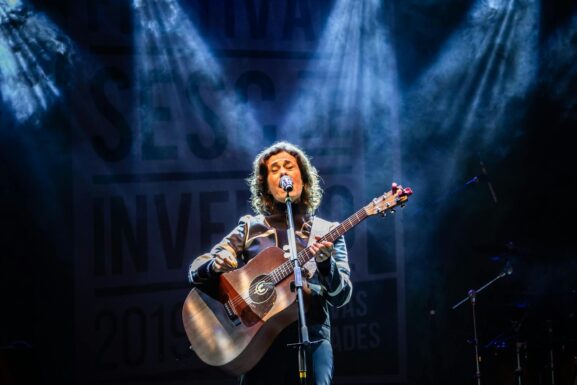
Today, the evolution continues. Contemporary artists like Mayra Andrade, Lura, and Nancy Vieira have brought a fresh, cosmopolitan approach to the genre. While respecting the traditional roots, they incorporate jazz, bossa nova, and even subtle electronic textures. This modernization ensures that Morna remains relevant to younger generations both in the islands and in the diaspora, preventing it from becoming a static “museum piece.”
UNESCO Recognition and National Pride
A pivotal moment in the history of the genre occurred in December 2019, when UNESCO inscribed Morna on the Representative List of the Intangible Cultural Heritage of Humanity. This recognition was more than just an honorary title; it was a validation of the resilience of Cape Verdean culture. It spurred a renewed interest in traditional luthiery (the making of instruments) and encouraged the government to integrate Morna into the national education curriculum.
Practical Guide: Where to Experience Morna Today
For travelers and music enthusiasts visiting Cape Verde, experiencing Morna is a rite of passage. While you can hear it on any island, two locations stand out:
- Mindelo, São Vicente: Known as the cultural capital, the city is filled with “Casas de Morna” and live music venues. Don’t miss the Baía das Gatas festival or a night at the iconic Livramento.
- Praia, Santiago: The capital city offers a vibrant nightlife where Morna is often blended with the more rhythmic Funaná and Batuku at venues like Quintal da Música.
The Future of the “Voice of the Islands”
The internationalization of Morna has been an extraordinary success story of cultural soft power. A tiny nation of half a million people managed to capture the world’s ear through the sheer emotional weight of its music. As new artists experiment with fusion and digital platforms allow for global reach, the core of Morna—the Sodade—remains unchanged. It remains the bridge between the islands and the rest of the world, a timeless melody that whispers of home, no matter how far one might roam.
Image: Pexels – damien Saillet