Darwin in Cape Verde: The HMS Beagle at Porto Praya
In January 1832, a young, largely unknown naturalist named Charles Darwin stepped off the HMS Beagle and onto the volcanic shores of Santiago Island in Cape Verde. While history often looks to the Galapagos Islands as the birthplace of Darwin’s theory of evolution, it was actually at Porto Praya (modern-day Praia) where his scientific genius first began to flicker to life. For 23 days, the arid, rugged landscape of this Atlantic archipelago served as Darwin’s first outdoor laboratory, providing the crucial geological evidence that would forever change his perspective on the natural world.
A Strategic Atlantic Outpost
Cape Verde, or Cabo Verde, is a horseshoe-shaped archipelago located roughly 570 kilometers off the coast of West Africa. At the time of the Beagle’s arrival in 1832, the islands had already spent nearly four centuries as a pivotal maritime hub. Discovered by Portuguese and Genoese navigators around 1456, the islands were uninhabited until the Portuguese established Ribeira Grande (now Cidade Velha) on Santiago—the first permanent European settlement in the tropics.
By the 19th century, Porto Praya had surpassed Ribeira Grande as the capital, serving as a vital resupply station for ships crossing the Atlantic. For Captain Robert FitzRoy and the crew of the Beagle, Porto Praya was a necessary stop for water and provisions. For 22-year-old Charles Darwin, however, it was an invitation to explore a world entirely different from the lush green hills of England.
The White Band in the Cliff: A Geological Revelation
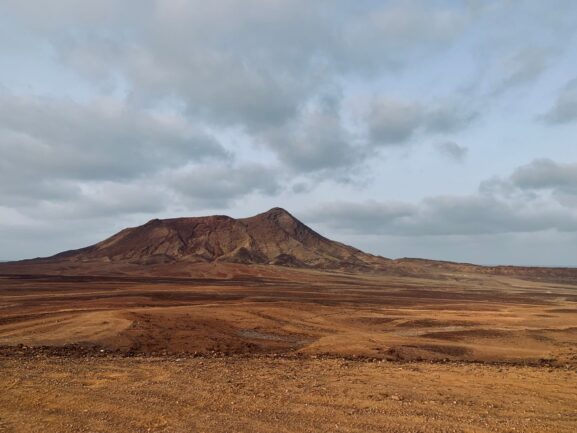
As the Beagle anchored in the harbor of Porto Praya, Darwin was immediately struck by the island’s stark, volcanic appearance. Writing in his journal, he noted the “arid undulating plain” and the “stunted, leafless” trees. However, his most significant observation occurred while walking along the coast of the harbor.
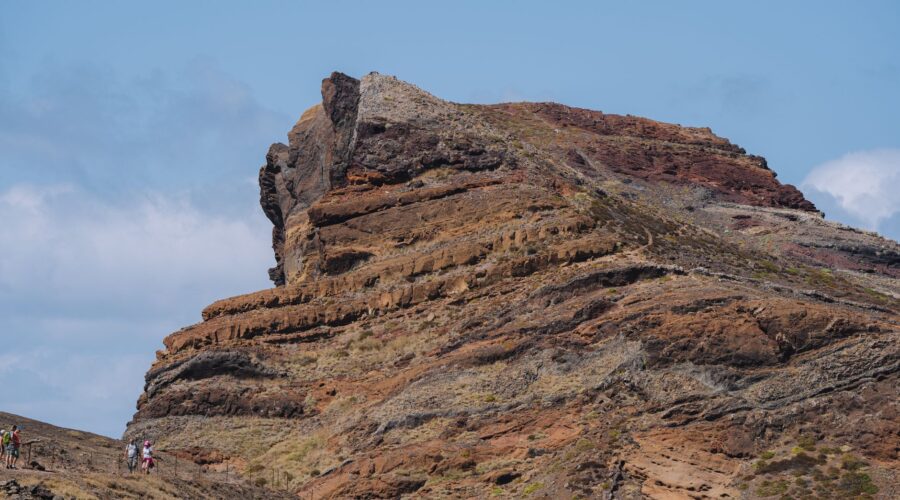
Darwin noticed a peculiar white horizontal band of crushed shells and coral embedded high up in the face of the sea cliffs, approximately 45 feet above sea level. This layer of marine remains was sandwiched between layers of dark, volcanic basalt. This observation was the “smoking gun” for a theory Darwin had been studying: Charles Lyell’s Principles of Geology.
Lyell argued that the Earth’s features were not formed by sudden, catastrophic biblical floods, but by slow, incremental processes over vast periods of time—a concept known as uniformitarianism. Seeing the ancient seabed perched high above the current ocean level, Darwin realized that the island of Santiago had been slowly pushed upward by volcanic forces over millions of years. This was the moment Darwin stopped simply reading about science and started practicing it. He later wrote, “It then first dawned on me that I might perhaps write a book on the geology of the various countries visited, and this made me thrill with delight.”
The Dust from Africa
While on Santiago, Darwin also investigated a meteorological phenomenon common to the Cape Verde Islands: the “Harmattan” dust. He observed a fine, reddish-brown dust that frequently coated the Beagle’s decks and obscured the horizon. Using his microscope, Darwin discovered that this dust was composed of tiny siliceous organisms (infusoria) and plant matter. He correctly deduced that these particles had been blown across the Atlantic from the African mainland, hundreds of miles away. This early foray into microbiology and atmospheric science demonstrated his meticulous attention to detail and his ability to connect local phenomena to global systems.
Flora and Fauna: Life in an Arid Environment
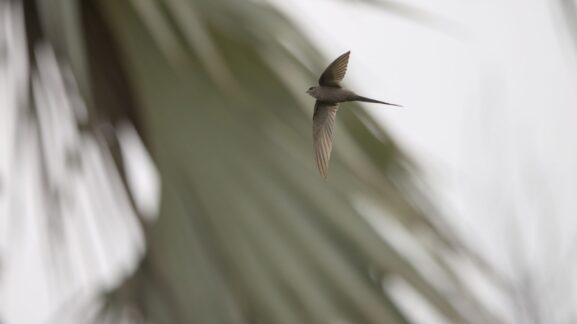
Though Darwin is most famous for his work on finches, his time in Cape Verde allowed him to study the resilience of life in extreme environments. He collected numerous specimens, including insects, birds, and marine life. He was particularly intrigued by the Iago sparrow (Passer iagoensis), an endemic species he first identified in Porto Praya.
Darwin also commented on the island’s peculiar climate. As part of the Macaronesia ecoregion, Cape Verde’s climate is moderated by the sea, but it remains significantly more arid than the African mainland. Darwin noted the “luxuriant vegetation” found only in deep damp ravines (orographically induced precipitation), contrasting sharply with the “burning” desert plains. This early exposure to endemic species and the way life adapts to isolated ecological niches laid the groundwork for his future observations in the Galapagos.
The Cultural Landscape of 1832
Darwin did not just observe the rocks; he observed the people. In 1832, Cape Verde was in the midst of an economic transition. The decline of the transatlantic slave trade—which had fueled the islands’ growth in the 16th and 17th centuries—had left the archipelago in a state of economic fragility. Darwin’s journals contain reflections on the local population, who are primarily of West African descent with Portuguese ancestry.
He visited the old capital of Ribeira Grande and described the ruins of the cathedral and the fortress, noting the “melancholy” atmosphere of a city that had once been the center of a thriving, albeit tragic, trade route. These human observations provided a social context to his scientific journey, illustrating the complex history of the “Green Cape” that was, in Darwin’s eyes, mostly brown and volcanic.
Legacy of the Beagle in Praia
Charles Darwin spent nearly a month in Porto Praya, and the impact of those 23 days cannot be overstated. It was here that he gained the confidence to challenge the scientific status quo. The geological formations of Santiago proved to him that the Earth was incredibly old and constantly changing—a necessary precursor to the idea that life itself could change over time.
Today, visitors to Praia can still see the same volcanic cliffs and the white “Darwin’s Band” that inspired the young scientist. Cape Verde has transitioned from a colonial stopping point to a stable, thriving democracy and a leader in renewable energy in Africa. Yet, for scientists and historians, the archipelago remains a sacred site: the place where Charles Darwin first began to see the world through the eyes of an evolutionist.
Practical Information for Travelers
- Getting There: Nelson Mandela International Airport in Praia receives flights from Europe, the Americas, and mainland Africa.
- Darwin’s Trail: History enthusiasts can visit the “Cidade Velha” (a UNESCO World Heritage site) and hike along the cliffs of Praia to see the layers of basalt and limestone Darwin described.
- Best Time to Visit: To experience the “Harmattan” dust Darwin observed, visit between December and February. For clearer skies and hiking, the months of October through June are ideal.
Image: Pexels – Diogo Miranda