Caminho dos Holandeses: Hiking São Nicolau’s Historic Trail
For many travelers, the archipelago of Cape Verde evokes images of the white sands of Sal or the volcanic peaks of Fogo. Yet, tucked away in the central group of islands lies São Nicolau, a rugged, mountainous sanctuary that feels like a secret kept by the Atlantic. Within this island of dramatic cliffs and verdant valleys lies one of the most historically significant and visually breathtaking hiking trails in West Africa: the Caminho dos Holandeses (The Path of the Dutch).
More than just a trekking route, the Caminho dos Holandeses is a living museum. It is a stone-paved testament to the 17th-century maritime history of the North Atlantic, offering hikers a chance to literally walk in the footsteps of sailors, traders, and privateers who once sought refuge and resources in the heart of São Nicolau.
The History: Why the Dutch Built a Path in the Mountains
To understand the significance of this route, one must look back to the mid-1600s. During this era, Cape Verde served as a vital crossroads for the transatlantic trade. The Dutch, who were ascending as a global maritime power through the Dutch West India Company, frequently navigated these waters.
Unlike the flat, arid islands nearby, São Nicolau offered something precious: reliable water sources and fertile soil. However, the island’s rugged topography made transporting goods from the interior to the coast a logistical nightmare. The Caminho dos Holandeses was constructed—legend says with the help of Dutch engineers or by locals trading with them—to connect the fertile valley of Ribeira Brava with the western ports.
The path allowed for the movement of coffee, sugar cane, and local spirits (grogue) to the coast, while bringing imported goods up into the mountain settlements. The stone paving (calçada), much of which remains intact today, was a feat of engineering designed to withstand the torrential rains of the tropical wet season and the heavy hooves of pack animals.
The Route: From Ribeira Brava to the Vertical Vistas
The modern trek usually begins in Ribeira Brava, the island’s colorful and historic capital. Leaving the cobblestone streets and colonial architecture behind, the trail immediately begins its ascent. The Caminho dos Holandeses is not for the faint of heart; it is a “vertical” experience that demands respect for the island’s steep geography.
Ascending the Monte Gordo Massif
As you climb, the air cools and the vegetation shifts. The trail snakes up the slopes toward the Monte Gordo Natural Park. One of the most striking features of this hike is the transition of landscapes. You move from the dry, sub-Saharan scrub of the lower elevations into a “cloud forest” environment near the summit.
The path itself is a marvel. The dry-stone walls that line the route have stood for centuries, acting as both a guide and a barrier against the steep drops. In many sections, the stones are worn smooth, polished by centuries of use. Looking down, you can see the zig-zagging patterns of the trail, a geometric scar across the emerald green mountainside.
The Peak of the Experience
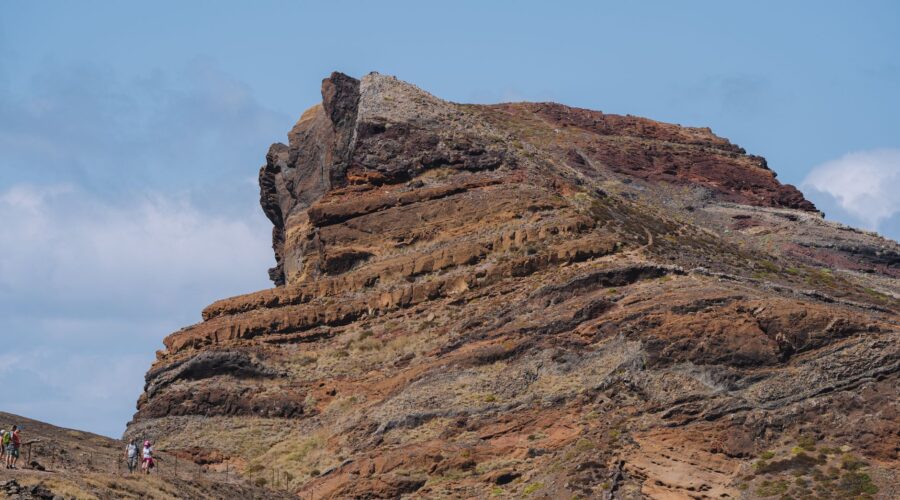
The pinnacle of the route offers what locals call “the view of the three seas.” On a clear day, from the higher ridges of the Caminho, you can look out across the Atlantic and see the neighboring islands of São Vicente and Santo Antão to the west, and the uninhabited Santa Luzia to the north. The “vertical vistas” here are literal—sheer cliffs drop hundreds of meters into deep valleys, where tiny patches of agricultural terraces (terrazos) cling to the slopes.
Flora and Fauna: A Biodiversity Hotspot
Trekking the Caminho dos Holandeses is also a lesson in Macaronesian botany. São Nicolau is home to several endemic species that found a refuge here. The most famous is the Dragon Tree (Dracaena draco). These prehistoric-looking trees, with their thick trunks and umbrella-like canopies, are scattered along the route. Their sap, known as “dragon’s blood,” was once a highly prized export for dyes and medicinal uses.
Birdwatchers should keep their eyes peeled for the Cape Verde Warbler or the Iago Sparrow. The silence of the mountains is often only broken by the wind and the occasional cry of a bird of prey circling the thermals rising from the valley floor.
Cultural Context: The Heart of São Nicolau
What sets this hike apart from European or American trails is the interaction with the local “Sannicolauense” culture. Along the route, you may encounter farmers tending to their “poios” (terraced gardens) or herding goats. The traditional greeting of “Bom dia” or “Tudo bem” is always accompanied by a smile.
The trail passes near small hamlets where life has changed little in decades. Here, the history of the 17th-century trade route feels immediate. You might see a trapiche (an ox-drawn sugar mill) still in use, producing the syrup that will eventually become the island’s famous grogue. This connection between the historical infrastructure and modern survival is the soul of São Nicolau.
Practical Information for Hikers
If you are planning to retrace the Caminho dos Holandeses, preparation is key. São Nicolau is less developed for tourism than Sal or Boa Vista, which is part of its charm, but it requires more self-sufficiency.
- Timing: The best time to hike is between November and June. The weather is cooler and the skies are generally clearer. During the rainy season (August–October), the stones can become dangerously slippery.
- Difficulty: Moderate to Strenuous. The elevation gain is significant, and the uneven stone paving requires sturdy hiking boots with good ankle support.
- Duration: Depending on your pace and the specific loop you choose, expect to spend 4 to 6 hours on the trail.
- Guides: While the path is marked in some areas, hiring a local guide is highly recommended. Not only do they ensure you don’t get lost, but they provide invaluable context regarding the medicinal plants and local legends of the Dutch era.
- Water and Supplies: There are no shops once you leave Ribeira Brava or the smaller villages. Carry at least 2-3 liters of water and high-energy snacks.
Why It Matters Today
In an era of over-tourism, the Caminho dos Holandeses represents a sustainable form of travel. It encourages the preservation of historical masonry and supports the local economy of the island’s interior. By walking this path, travelers contribute to the narrative that São Nicolau’s value lies not in sprawling resorts, but in its rugged heritage and natural splendor.
To walk the Caminho dos Holandeses is to experience a different side of Cape Verde—one where history is etched into the stone and the vistas remind you of the sheer scale of the Atlantic. It is a journey through time, a physical challenge, and a spiritual immersion into the “Morabeza” (hospitality) and majesty of São Nicolau.
Image: Pexels – Diogo Miranda