Tabanka: The Rhythms of Resistance on Santiago Island
On the island of Santiago, the rugged, mountain-strewn heart of the Cabo Verdean archipelago, there is a sound that vibrates deeper than the melody of a morna. it is the rhythmic, haunting call of the búzio (conch shell) and the frantic, disciplined beat of the drums. This is the sound of Tabanka—a cultural phenomenon that is far more than a parade. It is a living monument to resistance, a complex social structure, and a vibrant explosion of African heritage that has survived centuries of colonial suppression.
The Origins of Tabanka: A Shield Against Oppression
To understand Tabanka, one must look back to the 16th and 17th centuries. Cabo Verde, specifically Santiago, served as a central hub for the transatlantic slave trade. As enslaved people were brought from the West African coast to the islands, they carried with them their spiritual beliefs, social hierarchies, and musical traditions. In the face of a brutal colonial regime that sought to strip them of their identity, Tabanka emerged as a form of cultural and psychological resistance.
The word “Tabanka” is believed to derive from the Quimbundo word tábanka, meaning a fortified village or a place of protection. Initially organized under the guise of Catholic mutual-aid societies (confrarias) dedicated to saints like St. John the Baptist or St. Anthony, these groups allowed enslaved and marginalized populations to organize, support one another, and maintain their ancestral rhythms under the nose of the Portuguese administration. The colonial authorities frequently banned Tabanka throughout the 19th and early 20th centuries, fearing its ability to mobilize the masses, yet the tradition persisted in the shadows, emerging stronger with every attempt to silence it.
The Social Hierarchy: A Mockery of Empire
One of the most fascinating aspects of Tabanka is its internal structure. A Tabanka group (or chapéu) functions as a symbolic kingdom or a mock military state. It is a satirical mirror held up to the colonial administration. Within a Tabanka association, members hold specific titles: there is a King (Rei), a Queen (Rainha), governors, ambassadors, and even a “medical” corps and “police” force.
The “soldiers” of the Tabanka, known as ladrões (thieves) or marujos (sailors), often paint their bodies with charcoal or clay, carrying wooden rifles or staffs. During processions, they “arrest” onlookers or “steal” items, which must then be “ransomed” through a small donation to the association. This theatrical role-playing was a historic way for the marginalized to reclaim power, turning the rigid hierarchies of the Portuguese Empire into a game of communal celebration and satire.
The Ritual Procession
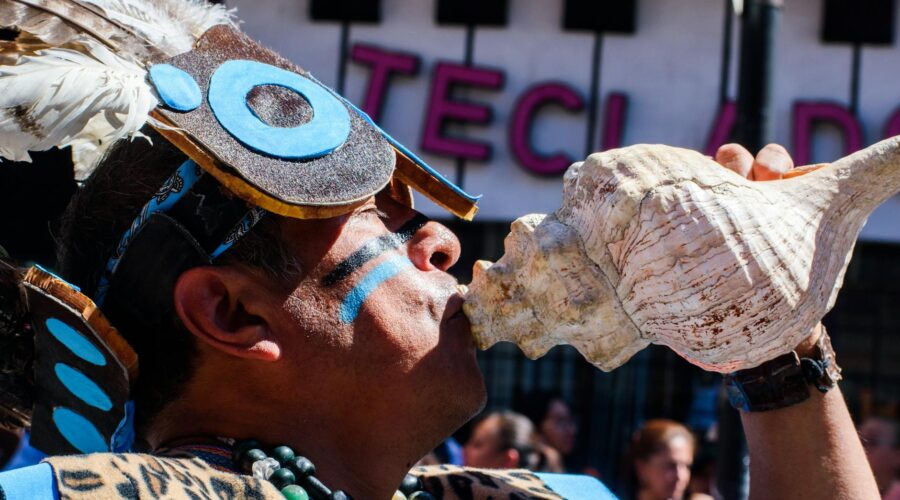
The Tabanka cycle usually peaks in the month of June, coinciding with the festivities of São João (St. John), São Filipe, and Santo António. The procession is a sensory overload. The corneteiro blows the conch shell with a sustained, piercing note that signals the movement of the group. Underneath this, the tamboreiros (drummers) maintain a relentless, syncopated beat known as the toque de Tabanka.
The movement is not a simple march; it is a rhythmic shuffle, a collective dance where the group moves forward and backward, symbolizing the ebb and flow of history and the resilience of the people. The King and Queen walk with regal dignity under decorated parasols, representing the spiritual and social sovereignty of the community.
The Music and the “Grito”
The music of Tabanka is distinct from the more famous Cabo Verdean genres like Cesária Évora’s morna or the upbeat coladeira. Tabanka is raw, percussive, and ritualistic. The búzio is the soul of the sound; as a marine instrument, it connects the island’s geography to its African roots. The call-and-response singing, led by the women of the group, often features improvised verses that comment on local events, spiritual themes, or the strength of the association.
There is also the grito (cry)—a sharp, vocal exclamation used to energize the participants and signal changes in the rhythm. This auditory landscape creates a trance-like atmosphere that binds the participants together, reinforcing a sense of “nha terra” (my land) and “nha povo” (my people).
Tabanka Today: Preservation and Identity
After Cabo Verde gained independence in 1975, the attitude toward Tabanka shifted. No longer a forbidden ritual, it was recognized as a cornerstone of national identity. Today, there are several active Tabanka “chapels” across Santiago, particularly in the neighborhoods of Praia (like Várzea and Achada de Santo António) and in rural municipalities like Santa Cruz and Assomada.
In 2019, the Tabanka was officially classified as Intangible Cultural Heritage of Cabo Verde. This designation has helped secure funding for the “Tabanka Museums”—small but vital cultural centers where the history of the movement is preserved. The Museu da Tabanka in Assomada and the one in Chão de Tanque are essential stops for any traveler wishing to delve deeper into the island’s soul.
Traveler’s Tips: Experiencing Tabanka
If you are planning a trip to Santiago to witness this cultural phenomenon, here is what you should know:
- Timing is Everything: The best time to see Tabanka is during the Month of June. The festivities surrounding São João (June 24th) are particularly intense and vibrant.
- Location: While the capital City of Praia has major processions, the most authentic and “raw” experiences are often found in the interior of the island, in the interior de Santiago.
- Respect the Ritual: While tourists are welcomed, remember that Tabanka is a deeply meaningful communal ritual with religious and historical weight. Always ask for permission before taking close-up photographs of the King or Queen.
- Listen for the Conch: If you are in Santiago during festival season, you don’t need a map to find the Tabanka. Just listen for the low, resonating drone of the conch shell and follow the sound toward the mountains.
A Spirit That Never Fades
Tabanka is a reminder that culture is a living, breathing entity. It was born from the struggle for dignity in the face of slavery and survived centuries of attempts to erase it. Today, as the youth of Santiago continue to pick up the conch shell and the drum, Tabanka remains a powerful symbol of Cabo Verdean “Morabeza” (hospitality) and “Resistência” (resistance). It is the heartbeat of Santiago Island—unbroken, unyielding, and profoundly beautiful.
Image: Pexels – Angel Rkaoz