Santa Luzia: The Uninhabited Island Drowning in 800 Tons of Plastic
Deep in the Atlantic Ocean lies Santa Luzia, Cape Verde’s only uninhabited island. While it should be a pristine sanctuary, its coastline tells a darker story. At Achados Beach, the tides have carved an “open wound” made of plastic, creating a graveyard for marine life and a monument to global neglect.
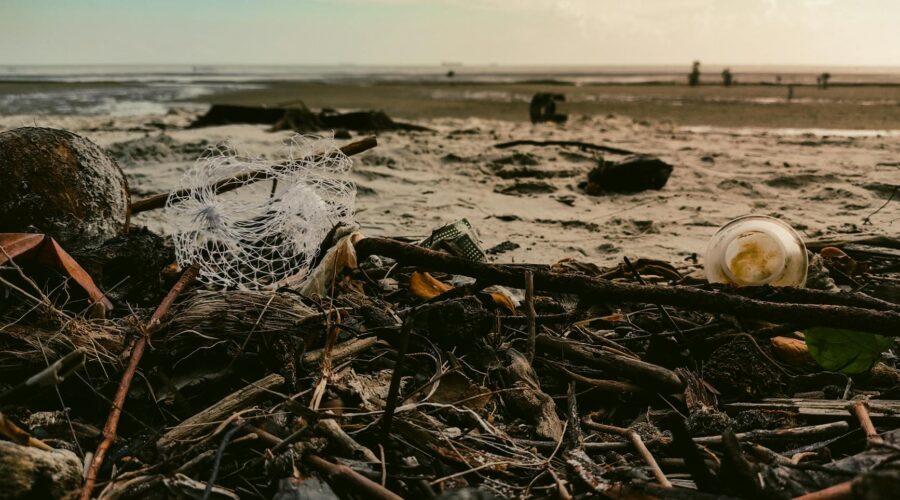
A partial natural reserve, Santa Luzia requires official authorization for any visitor. Yet, despite the absence of humans, the island is drowning in the world’s waste. The shoreline is a chaotic mosaic of wooden boards, shipping pallets, and a staggering variety of plastic packaging—some miraculously intact, most shattered into treacherous shards.
A Spoon Capturing the World’s Trash
“The beach is named ‘Findings’ because it was historically a place where items washed up,” says Tommy Melo, co-founder of the NGO Biosfera. “But today, almost everything we find is pollution.”
Melo has seen everything from LCD televisions to bottles bearing labels from dozens of different countries. However, the most consistent offenders are industrial fishing supplies: massive green nets stretching dozens of meters and brittle black plastic pots used for catching octopus in Morocco and Mauritania.
The geography of Santa Luzia makes it a perfect trap. Cape Verde sits in the path of the North Atlantic gyre and the Canary Current. Because Santa Luzia is the first landmass to meet these currents, and because Achados Beach curves like a spoon facing the northeast, it catches a disproportionate amount of the Atlantic’s debris. To make matters worse, a coral reef blocks boat access to the beach, making it nearly impossible to haul the trash away.
A Death Trap for Endangered Species
The pollution is more than an eyesore; it is a death sentence for the island’s most iconic inhabitants. Santa Luzia is a critical nesting ground for the endangered Loggerhead sea turtle (Caretta caretta). Between 2,000 and 5,000 nests are dug here annually, with 40% of the island’s adult turtles choosing Achados Beach.
“There is a high mortality rate on this beach because of plastics,” Melo explains. Both adult turtles and tiny hatchlings become ensnared in “ghost” fishing nets and lines. While mortality is naturally high for hatchlings, the plastic crisis causes those numbers to “grow exponentially.”
The 800-Ton Puzzle
Since 2011, Biosfera has organized annual cleaning campaigns. Each year, over 100 volunteers brave the sun to collect between 50 and 70 tons of waste before the nesting season begins in June. In 2025 alone, the team saved 50 adult turtles found tangled in debris.
However, the volunteers face a heartbreaking logistical nightmare. “Sometimes we feel discouraged,” says Keider Neves, Biosfera’s Conservation Coordinator. “It seems the more trash we remove, the more there is to take.”
Even more frustrating is the fact that the trash never actually leaves the island. Because the reef prevents boat access and vehicles are banned to protect the ecosystem, Biosfera has been forced to bury the waste in containment trenches. Today, an estimated 800 tons of plastic and wood sit packed in the sands of Santa Luzia, waiting for a way off the island.
A Glimmer of Hope
The impact extends beneath the waves. “Ghost fishing”—where lost nets continue to kill sharks and fish indefinitely—is rampant, and seabirds are frequently found with stomachs full of plastic. “There is more to be revealed,” Melo warns, noting that the damage to the surrounding coral reefs hasn’t even been fully assessed yet.
Biosfera is now pinning its hopes on a new project titled “Islands Without Plastic.” Launching this year with international expertise, the initiative aims to find a permanent, reusable solution to transport the waste off Santa Luzia. For now, the volunteers continue their uphill battle, fighting to keep an uninhabited paradise from being completely consumed by the world’s discarded plastic.
Image: Pexels – Ihsan Adityawarman