
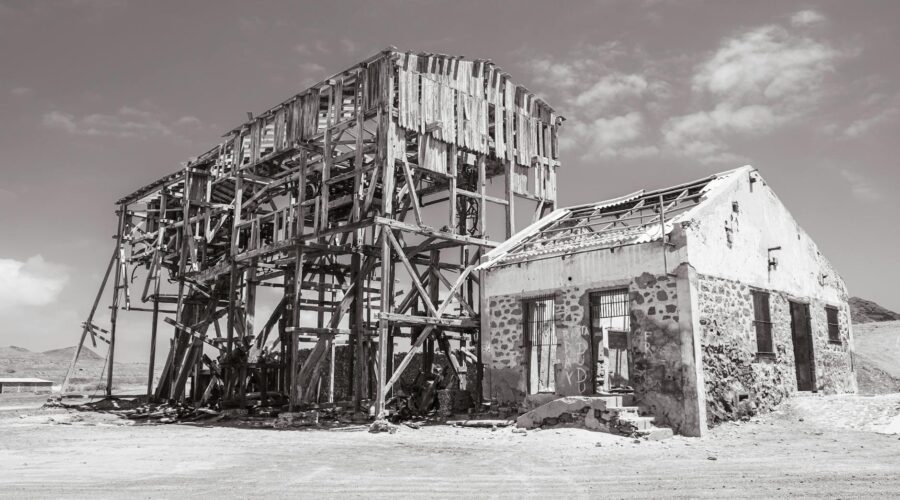
The Ghost Tracks of Sal: Cape Verde’s Forgotten Railway
In the middle of the shifting dunes and scorched volcanic plains of Sal, Cape Verde’s most popular tourist island, lies a secret buried under layers of basalt and salt. Most visitors flocking to the all-inclusive resorts of Santa Maria or the turquoise waters of Ponta Preta are unaware that they are walking over the remains of an industrial revolution that once transformed this barren archipelago. This is the story of the “Caminho de Ferro” — the ghost railway of Sal.
The Birth of an Industrial Vision
To understand why a railway was built on a small, arid island in the middle of the Atlantic, one must understand the “white gold” of Cape Verde: salt. The island of Sal (literally translating to “Salt”) owes its name and its modern history to the vast natural salt pans formed within the craters of extinct volcanoes, most notably at Pedra de Lume.
In the early 19th century, Manuel António Martins, a visionary businessman and colonial administrator, realized that the manual labor used to transport salt from the crater floor to the shore was inefficient. The demand for salt in Europe and the Americas was skyrocketing, primarily for food preservation. By 1835, the infrastructure at Pedra de Lume was being modernized, but it wasn’t until the turn of the 20th century, under the French company Salins du Cap-Vert, that the true technological leap occurred.
The Iron Arteries of the Island
While many assume Cape Verde has never had a rail system, Sal actually hosted two distinct industrial rail operations. The most famous was the animal-drawn (and later mechanized) narrow-gauge railway that connected the depths of the Pedra de Lume crater to the pier. This system replaced the grueling manual transport where workers carried heavy sacks of salt up the steep crater walls on their backs.
The railway was an engineering marvel for its time and location. Steel tracks were laid across the salt flats, and small wagons, known as “decauville” cars, were used to ferry tons of salt. At its peak, the sight of these iron tracks cutting through the white, crystalline landscapes of the crater offered a stark, futuristic contrast to the traditional, pastoral lifestyle of the island’s interior.
Pedra de Lume: The Engineering Heart
Today, visitors to Pedra de Lume can still see the most iconic remnants of this industrial era: the massive wooden pillars of the cable car system that eventually supplemented and then replaced the ground-level tracks. However, if you look closely at the ground near the old storehouses and the pier, the “ghost tracks” of the railway are still visible, partially reclaimed by the salty earth.
The railway served two primary functions. First, it streamlined the movement of salt from the crystallization ponds to the processing plant. Second, it transported the refined product to the long wooden pier where ships waited to carry the “White Gold” to Brazil and the West African coast. This period turned Sal from a sparsely populated outpost into a critical node in world trade.
The Santa Maria Connection
While Pedra de Lume was the industrial hub, the town of Santa Maria — now the island’s tourism capital — also had its own rail history. In the early to mid-20th century, a secondary network of tracks operated near the Santa Maria salt pans (Salinas de Santa Maria). These tracks were used to move salt toward the “Cais de Santa Maria” (the Santa Maria Pier), which remains the town’s most famous landmark today.
The “ghost tracks” of Santa Maria are harder to find, tucked away behind the modern hotels or buried under the sands of the ever-expanding beach. However, the presence of these tracks is what dictated the layout of the town’s oldest streets, which were designed to accommodate the movement of industrial carts rather than tourists.
Why the Tracks Fell Silent
The decline of the Caminho de Ferro of Sal was brought about by several factors. By the mid-20th century, the global market for salt shifted. The emergence of industrial refrigeration reduced the need for salt as a preservative. Furthermore, larger, more modernized salt mines in other parts of the world made the labor-intensive processes on Sal less competitive.
The coup de grâce came with the development of the Amílcar Cabral International Airport in the late 1930s and 1940s. As Sal pivoted toward aviation and eventually tourism, the industrial infrastructure was neglected. The steel rails, exposed to the harsh, corrosive salt air and Atlantic spray, began to disintegrate. The wood rotted, and the wagons were left to rust into orange skeletons against the blue sky.
Retracing the Tracks: A Guide for “Dark Tourism” Enthusiasts
For the modern traveler, retracing the ghost tracks of Sal offers a unique perspective on the island beyond the “No Stress” beach culture. Here is how you can find the remnants of Cape Verde’s only railway history:
1. The Pedra de Lume Crater
Pay the small entrance fee to enter the crater. Once inside, bypass the tourists floating in the medicinal waters and head toward the old machinery. You can still find sections of the narrow-gauge tracks embedded in the salt crust. The perspective from the bottom of the crater, looking up at the wooden transport pylons, gives you a sense of the immense scale of the operation.
2. The Old Warehouse at the Pier
Near the coast of Pedra de Lume, the ruins of the French company’s warehouses and the stone foundations of the railway terminus remain. It is a hauntingly beautiful site for photographers, where the red earth meets the rusted iron of the past.
3. The Santa Maria Cultural Center
In the heart of Santa Maria, some historical displays and old photographs show the “decauville” wagons in action. Walking from the salt pans toward the pier, look for any unusually straight, narrow paths—these often follow the original trajectory of the salt carts.
Preserving a Hidden Heritage
There is a growing movement in Cape Verde to preserve these industrial ruins. While the salt pans of Pedra de Lume are on the UNESCO World Heritage “Tentative List,” the railway history itself is often overlooked. Historians argue that the Caminho de Ferro represents a crucial bridge between Cape Verde’s colonial past and its modern identity as a hub of international transit.
The ghost tracks are more than just rusted metal; they are a monument to the resilience of the Cape Verdean people who worked these pans under a relentless sun. They represent the moment Sal was first connected to the global economy, long before the first Boeing landed on its runway.
Conclusion
The Caminho de Ferro of Sal is a whisper from a different age. In a world of five-star resorts and high-speed internet, these tracks remind us of a time when the island’s pulse was driven by the clinking of iron wheels and the harvesting of the sea. For those willing to look beneath the surface, Sal offers a rich, industrial narrative that is as compelling as its white-sand beaches. The next time you walk the shores of this desert island, listen closely—you might just hear the spectral rattle of the salt wagons, still rolling across the ghost tracks of the Atlantic.
Image: Pexels – Rob Mowe