The Cape Verde Rise: Geology of a Massive Oceanic Swell
Rising majestically from the depths of the eastern Atlantic Ocean, the Cape Verde archipelago is more than just a cluster of sun-drenched islands. Beneath the turquoise waters and volcanic peaks lies a geological phenomenon of global significance: the Cape Verde Rise. This massive oceanic swell represents one of the largest and most enigmatic protuberances on the Earth’s seafloor, providing scientists with a unique window into the inner workings of our planet.
What is the Cape Verde Rise?
The Cape Verde Rise is a vast bathymetric swell—a broad, elevated region of the ocean floor—that supports the ten volcanic islands and eight islets of the Republic of Cabo Verde. Covering a semi-circular area of approximately 1,200 square kilometers (460 square miles), the sea floor here rises significantly above the surrounding abyssal plains. On average, the swell elevates the crust by about 2.2 kilometers (1.4 miles), creating a massive “hump” in the Earth’s geoid.
While the islands themselves, such as Santiago, Fogo, and Sal, occupy a combined land area of only about 4,033 square kilometers, the underwater structure that supports them is gargantuan. The Rise is situated between 600 and 850 kilometers west of Dakar, Senegal, positioning it as the largest country off-continental Africa and a key member of the Macaronesia ecoregion alongside the Azores and Canary Islands.
The Volcanic Origins of the Archipelago
The story of the Cape Verde Rise began between 40 and 50 million years ago during the Eocene epoch. However, the magnetic anomalies in the surrounding seafloor suggest that the underlying crustal structures could be as old as 125 to 150 million years. The oldest exposed rocks, found on the island of Maio and the northern reaches of Santiago, are pillow lavas dating back roughly 130 million years—remnants of ancient underwater volcanic eruptions.
The islands are primarily composed of igneous rocks. These include volcanic structures and pyroclastic debris, belonging to a “soda-alkaline petrographic province.” This means the chemical makeup of the rocks is rich in sodium and potassium, a signature shared with other volcanic island chains in the Macaronesian region.
A Tale of Two Island Groups
The Cape Verde archipelago is spatially divided by its geography and geological age into two distinct groups:
- The Barlavento (Windward) Islands: Comprising Santo Antão, São Vicente, Santa Luzia, São Nicolau, Sal, and Boa Vista.
- The Sotavento (Leeward) Islands: Comprising Maio, Santiago, Fogo, and Brava.
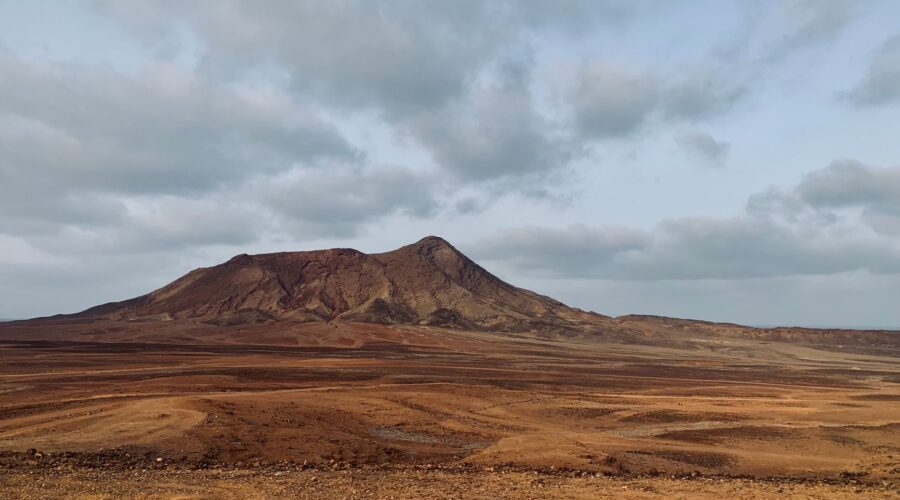
Geologically, there is a clear progression in age. The eastern islands like Sal and Maio are older (dating back roughly 20 million years), flatter, and feature extensive salt flats. In contrast, the western islands are younger (around 8 million years old) and significantly more rugged, with towering mountains and active volcanic features.
Pico do Fogo: The Living Heart of the Rise
While much of the archipelago’s volcanic activity peaked during the Miocene epoch, the geological engine of the Cape Verde Rise remains very much alive. Historical volcanism within the period of human settlement has been concentrated on the island of Fogo.
Pico do Fogo is the region’s largest active volcano, standing as a testament to the ongoing tectonic forces. Its most recent eruption occurred in 2014. The island features an impressive eight-kilometer-diameter caldera, formed when a magma chamber partially collapsed. The interior cone of the volcano rises to a staggering 2,829 meters (9,281 feet) above sea level, making it the highest point in Cape Verde and a primary focus for volcanologists worldwide.
The Hotspot Theory and Oceanic Swells
Why does the Cape Verde Rise exist? Most geologists attribute this massive swell to a “mantle plume” or hotspot. Unlike the volcanic activity at the edges of tectonic plates (like the Ring of Fire), hotspots occur in the middle of plates. A plume of hot magma rises from deep within the Earth’s mantle, thinning the lithosphere and pushing the ocean floor upward to create a swell.
The Cape Verde Rise is particularly interesting to researchers because the African Plate, on which the islands sit, is moving very slowly. This slow movement has allowed the heat from the mantle plume to accumulate under a specific area for a long time, resulting in one of the most prominent and high-standing oceanic swells on the planet.
Environmental and Climatic Implications
The geology of the Rise does more than just create land; it dictates the climate and survival of the nation. The steep volcanic mountains of islands like Santiago and Santo Antão create “orographic precipitation.” As humid Atlantic air hits these peaks, it condenses, allowing for the growth of lush laurel forests and dry monsoon forests in an otherwise arid region.
Conversely, the flatter islands like Sal receive very little rainfall—sometimes less than 100mm annually—confirming their status as desert environments. This geological diversity has led to a high rate of endemism, with species like Alexander’s swift and the Raso lark evolving in isolation on these volcanic outcrops.
The “Hurricane Nursery”
The Cape Verde Rise also plays a role in global weather patterns. The islands are located in a region where “Cape Verde-type hurricanes” form. These storms start as atmospheric disturbances near the islands and gain strength as they travel across the warm Atlantic toward the Americas. Because they have thousands of miles of open water to develop, Cape Verde hurricanes are often the most intense and long-lived storms of the Atlantic season.
Preserving a Geological Treasure
Today, the Republic of Cabo Verde is recognized as a “success story” in Africa—a stable democracy with a growing economy focused on tourism and foreign investment. However, the nation remains vulnerable to the forces that created it. As one of the most endangered nations due to climate change-induced flooding, the country is leading the way in renewable energy, aiming for 50% renewable power by 2030.
In a groundbreaking 2023 agreement, Portugal signed a “debt-for-nature” swap with Cape Verde, forgiving €140 million in debt in exchange for environmental investments. This ensures that the unique biodiversity and geological wonders of the Cape Verde Rise are protected for future generations of residents and researchers alike.
Conclusion
The Cape Verde Rise is a marvel of the natural world. From its ancient pillow lavas and active calderas to its role in steering global climate patterns, this oceanic swell is a cornerstone of Atlantic geology. For the visitor, the islands offer stunning landscapes of black sand and green peaks; for the scientist, they offer a lifetime of questions about the hidden fires that shape our world.
Image: Pexels – Bibi Kiekens