Educational Reform in Cape Verde: Building a Digital Future
In the heart of the central Atlantic Ocean, the archipelago of Cape Verde (Cabo Verde) has long been recognized as a beacon of democratic stability and social progress in West Africa. However, as the global economy shifts toward digitalization and high-tech services, this small island nation has realized that its most valuable resource is not its volcanic soil or its turquoise waters, but its human capital. To harness this potential, the Cape Verdean government has embarked on a series of ambitious educational reforms designed to transform a traditional colonial-era system into a modern, inclusive, and future-ready powerhouse.
The Historical Context: From Literacy to Quality
Following independence from Portugal in 1975, Cape Verde faced a daunting challenge: a literacy rate of less than 25%. The initial decades of educational policy were focused on “quantity”—building schools on every inhabited island and ensuring that every child had a seat in a classroom. This mission was largely successful; today, Cape Verde boasts one of the highest literacy rates in Africa, exceeding 86% for adults and nearly 99% for youth.
However, the 21st century brought a new realization. While students were in school, the curriculum was often outdated, the transition to secondary school saw high dropout rates, and the mismatch between university degrees and the actual needs of the labor market was widening. The current wave of reform, accelerated over the last decade, shifts the focus from “access” to “quality and relevance.”
Strategic Pillars of Modern Reform
The Cape Verdean Ministry of Education, supported by international partners like the World Bank and the African Development Bank, has structured its reform around several critical pillars. These reforms aim to align the country with the United Nations’ Sustainable Development Goal 4: Quality Education.
1. Extending Compulsory Education
One of the most significant structural changes has been the extension of free and compulsory education. Previously ending at the 6th grade, the government has moved to extend this through the 8th, and eventually the 12th grade. By removing the financial and structural barriers to secondary education, the state is attempting to curb the “brain drain” that occurs when students drop out in their early teens to enter informal labor markets.
2. The Linguistic Transition
Cape Verdean education is navigating a unique linguistic landscape. While Portuguese is the official language and the medium of instruction, Cape Verdean Creole (Kriolu) is the mother tongue of virtually the entire population. Recent reforms have introduced pilot programs to use Creole as a bridge in early childhood education to improve comprehension, while simultaneously strengthening the teaching of English and French. The goal is to produce polyglot graduates who can function in the Lusophone world while competing in the global tourism and tech sectors.
3. Digital Transformation and “WebLab”
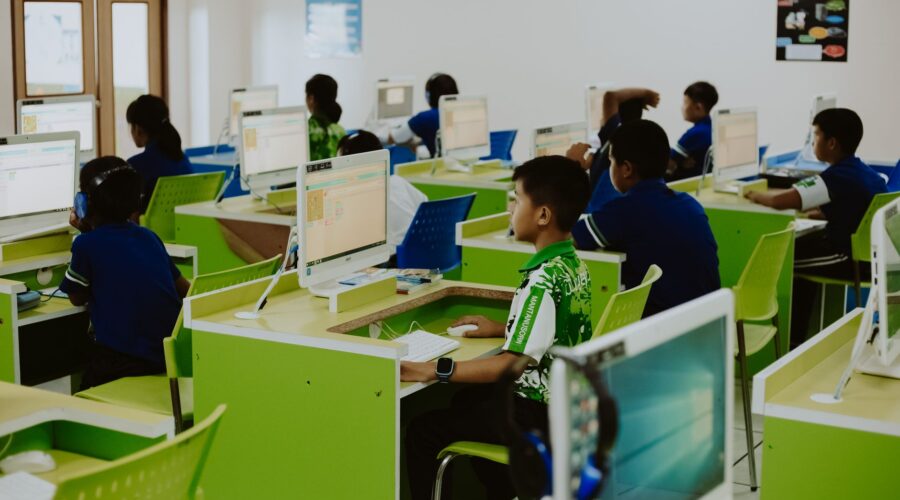
Perhaps the most visual element of Cape Verde’s educational reform is the “WebLab” initiative. In partnership with technology giants, the government has deployed containerized digital laboratories to secondary schools across the islands. These labs provide students with access to robotics, 3D printing, and coding classes. By integrating Information and Communication Technology (ICT) into the core curriculum, Cape Verde aims to become a “Digital Hub” for the mid-Atlantic, positioning its youth to work remotely for international firms.
Technical and Vocational Education and Training (TVET)
For decades, there was a cultural stigma in Cape Verde that favored academic university degrees over technical skills. The result was a surplus of law and social science graduates and a shortage of skilled electricians, renewable energy technicians, and hospitality managers.
The reform has pivoted toward strengthening TVET. New vocational centers, such as the CERMI (Center for Renewable Energy and Industrial Maintenance) in Praia, are now international benchmarks. These institutions offer certifications that are recognized across ECOWAS (Economic Community of West African States), allowing Cape Verdean technicians to be mobile and competitive. The curriculum is now developed in direct consultation with the private sector to ensure that what is taught in the classroom is exactly what is needed in the field.
Higher Education and Research
Cape Verde’s university landscape is relatively young, with the public University of Cape Verde (Uni-CV) established only in 2006. The reform here is focused on research and internationalization. The new Uni-CV campus in Praia, funded by Chinese cooperation, provides state-of-the-art facilities that allow for increased research into climate change, marine biology, and sustainable agriculture—fields that are vital to the survival of a Small Island Developing State (SIDS).
Challenges and the Path Ahead
Despite the optimism, the path to reform is not without hurdles. The geography of the archipelago presents a perennial challenge; delivering the same quality of education to a small village on the mountainous island of Santo Antão as to the capital city of Praia is expensive and logistically complex.
Furthermore, the COVID-19 pandemic exposed the “digital divide.” While the WebLabs were a start, many students in rural areas lacked the home internet access or devices necessary for remote learning. Addressing this inequality remains a top priority for the Ministry of Education as they move toward a “blended learning” model.
Teacher training is another critical area. A curriculum is only as good as the person delivering it. The government has increased investment in the continuous pedagogical training of teachers, moving away from rote memorization toward a “competency-based” approach that encourages critical thinking and problem-solving.
Conclusion: The Blueprint for a Resilient Future
Educational reform in Cape Verde is more than just a policy shift; it is a survival strategy. As a nation with no mineral wealth and limited rainfall, Cape Verde understands that its future depends on the intellectual agility of its citizens. By investing in bilingualism, digital literacy, and technical expertise, the country is transforming itself from a remote archipelago into a connected, global participant.
For investors, international organizations, and the Cape Verdean diaspora, these reforms signal a country that is “open for business” and ready to lead by example. While the full results of these changes will take a generation to manifest, the foundation currently being laid suggests that Cape Verde’s greatest exports in the future will be innovation, expertise, and a highly skilled workforce.
Fast Facts about Education in Cape Verde
- Primary Enrollment: Over 95%
- Compulsory Education: Currently being extended to 12 years.
- Languages of Instruction: Portuguese (official), with increasing emphasis on English, French, and Cape Verdean Creole.
- Innovation Hubs: 40+ WebLabs installed across all nine inhabited islands.
Image: Pexels – Ron Lach