Bocona Architecture: The ‘Big Mouth’ Houses of Ribeira da Barca
Nestled on the western coast of the island of Santiago, the fishing village of Ribeira da Barca serves as a living museum of Cape Verdean resilience and ingenuity. While the village is known for its rugged coastline and vibrant maritime culture, it holds a unique architectural secret that fascinates historians and architects alike: the Bocona.
Translated literally as “Big Mouth,” the Bocona houses are distinctive storage structures that dot the landscape of this coastal community. More than just functional buildings, these edifices are silent narrators of the 19th and 20th-century socioeconomic dynamics in Cabo Verde. They represent a fusion of necessity, class symbolism, and a specific response to the archipelago’s historical vulnerability to famine and isolation.
What is a Bocona? Defining the Architecture
The Bocona is a specific typological variation of the traditional Cape Verdean stone house. Its defining characteristic—and the source of its name—is the oversized, arched entrance or window, usually located on the upper level or dominating the facade. Architecturally, these structures were built using locally sourced volcanic basalt and limestone, held together by a lime-based mortar or, in older iterations, simple clay.
Unlike the funco (the circular, thatched-roof hut of the rural poor) or the sobrado (the elite colonial two-story manor), the Bocona occupies a middle ground. It is typically a sturdy, rectangular structure with thick walls designed to maintain a cool internal temperature. The “Big Mouth” served a dual purpose: it allowed for the easy hoisting of large sacks of grain, pulses, and dried fish, and it provided essential ventilation to prevent mold in a humid maritime environment.
The History: A Fortress Against Famine
To understand the rise of the Bocona in Ribeira da Barca, one must look at the dark history of the “Famines of the North.” For centuries, Cape Verde suffered from cyclical droughts that decimated populations. In this context, food was more than sustenance; it was currency, security, and survival.
Ribeira da Barca functioned as a critical port for the interior of Santiago. Goods arriving from other islands or from the Portuguese metropole were offloaded here before being transported by mule to the agricultural heartlands of Santa Catarina. The Bocona houses emerged as the primary infrastructure for this trade. Merchants and wealthy landowners built these “Big Mouth” warehouses to stockpile maize, beans, and purgueira (physic nut) seeds.
During the late 19th century, the Bocona became a symbol of the “morgado” system—a form of land entailment. Having a Bocona filled with grain meant that a family could survive a two-year drought without external aid, elevating their status from mere residents to local power brokers.
Social Symbolism: The “Big Mouth” as a Status Symbol
In the social hierarchy of Ribeira da Barca, the size and prominence of one’s Bocona sent a clear message to the community. A large, well-maintained “Big Mouth” was a visible display of wealth. It signaled that the owner was a person of posses (means), capable of employing others and influencing the local economy.
Interestingly, the Bocona also represents a transition in Cape Verdean identity. While the elite in the capital of Praia were building neoclassical villas to mimic Lisbon, the burgeoning merchant class in Ribeira da Barca created an architecture that was unapologetically functional and adapted to the local climate. The Bocona was a Creole architectural expression—born of African masonry techniques and European storage concepts, distilled through the lens of Atlantic trade.
The Interior Logic
Inside a Bocona, the space is usually divided into two levels. The lower level often housed livestock or served as a workspace for salting fish. The upper level, accessed by the “Big Mouth,” was the sanctum where the most valuable harvests were kept. The high ceilings and thick walls created a microclimate, essential for preserving the milho (corn) that remains the staple of the Cape Verdean diet today.
Ribeira da Barca: The Geographical Context
The location of these houses is no accident. Ribeira da Barca sits at the mouth of a deep valley, providing a natural path from the sea to the fertile highlands. The village’s topography—steep cliffs and narrow shorelines—forced builders to think vertically. The Bocona houses are often built into the slopes, with the “Big Mouth” facing the sea, almost as if the buildings themselves were waiting to swallow the cargo arriving from the Atlantic.
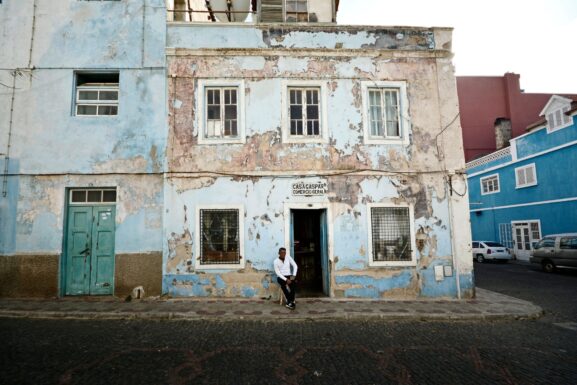
Visitors today can still see these structures lining the main thoroughfares of the village. While many have been converted into modern residences, their distinctive oversized openings remain, often framed by decorative stonework that distinguishes them from the simpler modern cement houses.
Preservation and the Future of the Bocona
As Cape Verde modernizes, the traditional Bocona architecture faces significant threats. The introduction of reinforced concrete and the shift away from artisanal masonry have led to the abandonment or demolition of many original structures. The specialized knowledge required to maintain lime-and-stone walls is also fading as younger generations move toward faster, cheaper construction methods.
However, there is a growing movement among Cape Verdean architects and historians to recognize the Bocona as a piece of National Cultural Heritage. Efforts are being made to document these structures and encourage adaptive reuse—turning these historic warehouses into boutique guesthouses, museums, or cultural centers that celebrate the maritime history of Santiago.
Why it Matters for Travelers
For the culturally conscious traveler, visiting Ribeira da Barca to see the Bocona houses offers a deeper understanding of the “Morabeza” (hospitality) and resilience of the Cape Verdean people. It is a reminder that in this “country of the sea,” every building was designed with an eye on the horizon and a heart prepared for the next harvest.
Practical Information for Visitors
- How to get there: Ribeira da Barca is approximately a 1-hour to 1.5-hour drive from Praia. You can take a aluguer (shared minibus) from the Sucupira market in Praia heading towards Assomada, and then a connecting transport to the coast.
- What to look for: Walk through the older quarters of the village near the waterfront. Look for two-story stone buildings with unusually large, arched upper windows.
- Best time to visit: The village is most vibrant during the Festival of Santa Cruz in May, though the architecture is best photographed in the soft afternoon light of the dry season (November to June).
Conclusion
The Bocona of Ribeira da Barca is more than a relic of a bygone era; it is a structural testament to the Cape Verdean spirit. In its “Big Mouth,” we find the stories of merchants who braved the Atlantic, farmers who battled the dust, and a community that turned the necessity of storage into a unique architectural legacy. To decode the Bocona is to understand the very DNA of Santiago island—a blend of survival, status, and stone.
Image: Pexels – Piotrek Wilk