António Cotrim: 40 Years of Lusa News Agency History
At 68 years old, photojournalist António Cotrim is more than just an employee at Lusa; he is the living memory of Portugal’s national news agency. As Lusa celebrates its 40th anniversary this year, Cotrim stands as its longest-serving staff member—a man whose career has tracked the evolution of Portuguese democracy through a camera lens.
From News Courier to National Witness
Cotrim’s journey began long before the digital age. In 1974, at the age of 16, he started as a news distributor for the Lusitânia agency. His transition to professional photography came in 1983 at ANOP, but it was a meeting on April 29, 1986, that would change his life. Assigned to cover a high-level government meeting, Cotrim captured the moment the merger between the ANOP and NP agencies was approved, paving the way for the birth of Lusa.
In those early days, photojournalists were the “illustrious unknowns” of the newsroom. “We didn’t have the recognition we have today,” Cotrim recalls. “We were dependent on reporters and photographed whatever they determined.”
A Moment of Glory in Riyadh
Cotrim’s rise to national prominence came in 1989 when he was sent to cover the FIFA World Youth Championship in Riyadh. Portugal secured its first-ever world football title, and Cotrim was the only Portuguese photojournalist on the ground. “It was my moment of glory,” he says. “My photos were appearing everywhere daily.”
Over a 43-year career, he has documented everything from high-stakes politics and war zones to fashion and sports. His portfolio includes iconic images such as Princess Diana crossing a minefield in Angola in 1997 and a haunting 2012 report on the Tarrafal Penal Colony in Cape Verde. He also developed a deep bond with Timor-Leste, documenting the nation’s struggle and hope through its people’s faces since its independence in 2002.
The Evolution of the Newsroom
Cotrim remembers the pre-Lusa era as one of the “coolest periods of Portuguese journalism,” characterized by fierce official competition but deep unofficial camaraderie. While management ordered rival agencies not to speak to one another, photographers on the ground secretly coordinated equipment and shared materials.
Eventually, the creation of Lusa brought stability to a workforce exhausted by political uncertainty. However, as he nears retirement, Cotrim views the modern media landscape with a critical eye. He laments the rise of “populist” journalism and the obsession with constant “breaking news” alerts.
“Today there is something terrible in journalism: the alerts,” Cotrim says. “There’s an alert about a serious fire, and when you get there, it’s just someone lighting a lighter. People think quantity is quality. We have quantity and little quality.”
A Legacy Preserved
Even as he prepares to hang up his camera in a year’s time, Cotrim remains dedicated to his craft and his “home.” He recently spearheaded the creation of the Lusa Museum Nucleus at the agency’s Lisbon headquarters to ensure the history of Portuguese news gathering is never forgotten. He also continues to lead “A Solidary Image,” an annual initiative that rallies photographers to support social causes.
As the “oldest” witness to Lusa’s history, Cotrim maintains that despite the changing technology and frantic pace of news, the agency’s greatest asset remains its credibility—a standard he has helped uphold for four decades.
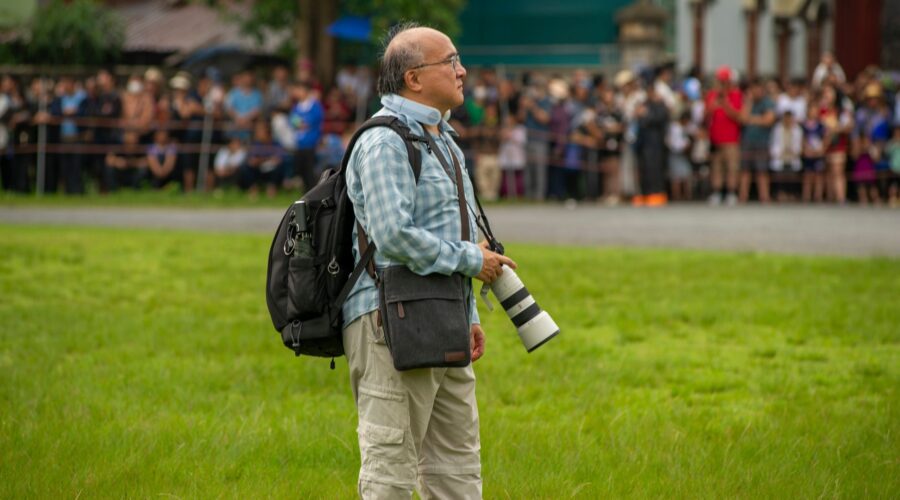
Image: Pexels – Vietnam Hidden Light