The Cape Verde Rise: Geological Formation of the Islands
Floating in the vast expanse of the central Atlantic Ocean, the archipelago of Cape Verde (Cabo Verde) stands as a testament to the violent and creative power of the Earth’s interior. While many travelers know these islands for their vibrant Creole culture, soulful Morna music, and stunning volcanic landscapes, geologists view them as a scientific marvel. At the heart of this fascination is the Cape Verde Rise, a massive geological feature that played a pivotal role during the Eocene epoch, setting the stage for the birth of an entire nation.
The Eocene Awakening: 40 to 50 Million Years in the Making
To understand Cape Verde today, one must travel back approximately 40 to 50 million years to the Eocene epoch. This was a time of significant transition for the planet, and deep beneath the ocean floor off the coast of West Africa, tectonic forces were preparing to reshape the Atlantic map. During this period, the foundations of the Cape Verde archipelago began to take shape.
While the islands we see today—such as the bustling Santiago or the volcanic Fogo—are relatively young in geological terms (with most visible land dating between 8 and 20 million years), the underlying structures and the initial thermal activity began much earlier. This Eocene “awakening” was fueled by the Cape Verde Rise, a bathymetric swell that remains one of the largest ocean protuberances on Earth.
What is the Cape Verde Rise?
The Cape Verde Rise is a staggering geological phenomenon. It is a semi-circular region covering approximately 1,200 square kilometers, rising 2.2 kilometers (1.4 miles) above the surrounding seafloor. This “bulge” in the Earth’s crust is associated with a rise in the geoid, suggesting a powerful upwelling of heat and magma from deep within the mantle, often referred to as a “hotspot.”
During the Eocene, this rise acted as a massive pedestal. As the African tectonic plate moved slowly over this stationary hotspot, the intense heat thinned the lithosphere and pushed the ocean floor upward. This elevation was the essential precursor to island formation. Without the Cape Verde Rise, the volcanic eruptions that followed might never have reached the ocean’s surface to form the ten islands and eight islets we recognize today.
A Petrographic Province of Fire
The geology of Cape Verde is dominated by igneous rocks. The archipelago is classified as a soda-alkaline petrographic province, sharing a similar chemical DNA with other Macaronesian archipelagos like the Canary Islands and the Azores. The islands are primarily composed of volcanic structures and pyroclastic debris—the “fire-broken” fragments of ancient eruptions.
Interestingly, some of the oldest rocks found on the islands, particularly the pillow lavas on Maio and the northern peninsula of Santiago, date back even further than the Eocene, to 128–131 million years ago. These ancient oceanic crust fragments were thrust upward by the same forces that created the Rise, providing a rare glimpse into the deep history of the Atlantic floor.
From Deep Sea to Archipelago: The Stages of Growth
Following the initial Eocene uplift, the islands underwent several stages of development:
- The Pre-Emergence Phase: Deep-sea volcanic activity built the foundations upon the Cape Verde Rise.
- The Miocene Peak: The first major stage of subaerial (above water) volcanism began in the early Miocene. This was the archipelago’s “growth spurt,” where the islands reached their maximum physical sizes.
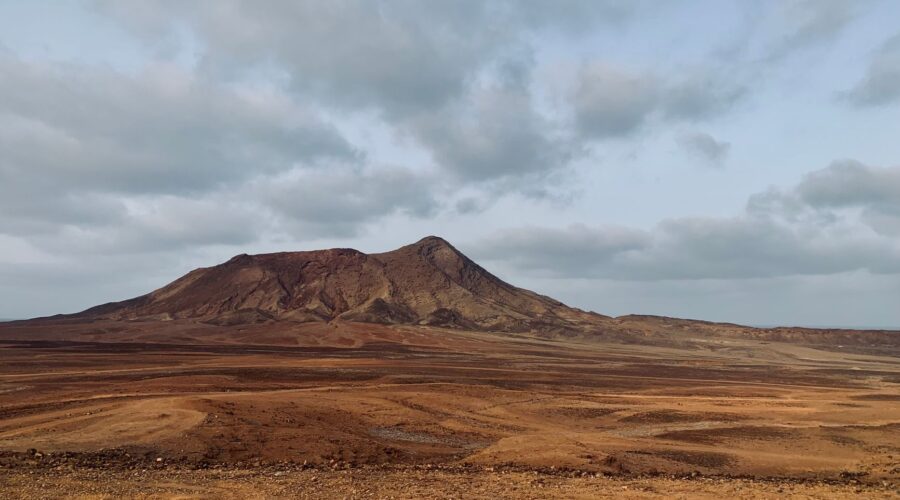
- Erosion and Subsidence: Over millions of years, wind and waves battered the islands. While flat islands like Sal and Maio represent older, more eroded landscapes with extensive salt flats, mountainous islands like Fogo continue to be shaped by active volcanism.
Fogo: The Living Legacy of Volcanic Power
The geological story that began in the Eocene is far from over. Fogo, the “Island of Fire,” serves as a modern laboratory for understanding the forces that built the Cape Verde Rise. Pico do Fogo, the region’s largest active volcano, stands at 2,829 meters above sea level. Its most recent eruption in 2014 reminded the world that the hotspot beneath the Cape Verde Rise is still very much alive.
The island’s massive eight-kilometer-wide caldera is a result of subsidence—where the land collapsed into a partially emptied magma chamber. This process is a microcosm of the violent geological history that has defined the archipelago for nearly 50 million years.
Geology Shaping Culture and Economy
The unique formation of the islands via the Cape Verde Rise has directly influenced the nation’s history and modern identity. The lack of traditional natural resources, a result of the islands’ purely volcanic origin, led to a service-oriented economy. However, the very geology that made farming difficult—steep mountains and volcanic soil—created the dramatic landscapes that now drive a thriving tourism industry.
Furthermore, the islands’ strategic position in the Atlantic, a result of their specific volcanic placement 570 kilometers off the coast of Senegal, made them a historical crossroads. From the early Portuguese settlements in 1462 at Ribeira Grande (now Cidade Velha) to serving as a vital stop for Charles Darwin’s HMS Beagle in 1832, the islands’ physical coordinates have defined their destiny.
Environmental Challenges and the Future
Today, Cape Verde faces new challenges born of its geography. As an archipelago, it is on the frontlines of the climate crisis. In 2011, it was ranked the eighth most endangered nation due to flooding from climate change. Yet, the nation is turning to its volcanic and atmospheric environment for solutions, aiming to generate 50% of its energy from renewable sources by 2030.
Conclusion
The Cape Verde Rise is more than just a hump on the ocean floor; it is the silent architect of a nation. By pushing the Earth’s crust toward the heavens during the Eocene epoch, it created a sanctuary for unique biodiversity and a home for a resilient, vibrant population. From the ancient pillow lavas of Maio to the smoking peak of Fogo, the geological journey of Cape Verde is a 50-million-year epic that continues to evolve with every Atlantic wave.
Image: Pexels – Bibi Kiekens