The Architecture of Water: Cape Verde’s Levadas & Cisterns
In the middle of the Atlantic Ocean, the volcanic archipelago of Cape Verde (Cabo Verde) stands as a testament to human ingenuity against the forces of nature. For centuries, the inhabitants of these ten islands have faced a relentless challenge: drought. Located within the Sahelian belt, the islands—particularly the more mountainous ones like Santo Antão, São Nicolau, and Brava—reach skyward with dramatic peaks that capture passing clouds but offer little in the way of natural, year-round water storage. To survive, the “Caboverdianos” engineered an intricate architectural marvel: the levadas and ancient cistern systems.
These gravity-defying channels and subterranean vaults are more than just infrastructure; they are the lifelines of the islands. They represent a blend of Portuguese colonial engineering and local adaptation, creating a unique water culture that remains vital today. Understanding the architecture of these systems is key to understanding the resilience of the Cape Verdean people.
The Levadas: Veins of the Mountains
The word levada is derived from the Portuguese “levar,” meaning to carry. Originally inspired by the world-famous irrigation channels of Madeira, the Cape Verdean levadas were adapted to a much harsher, more arid environment. Unlike the lush, wet slopes of Madeira, Cape Verde’s mountains are often crumbly basalt and porous volcanic rock where every drop of water is a precious commodity.
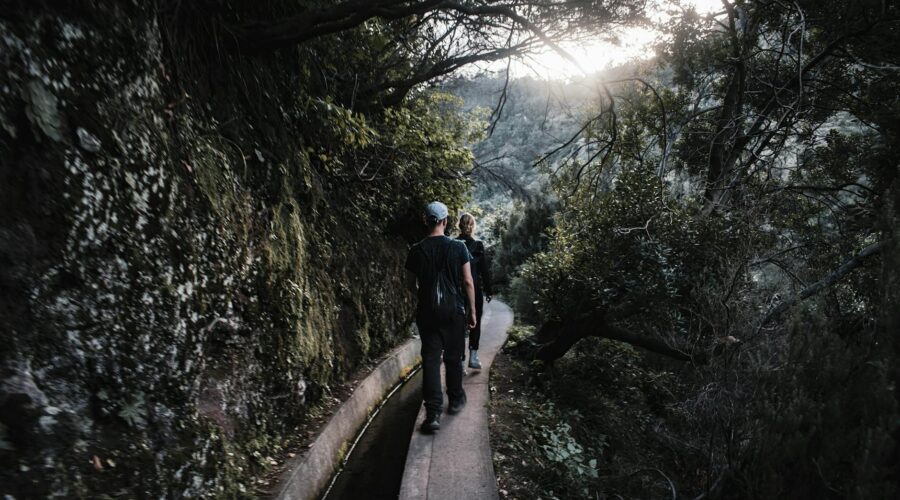
The architecture of a levada is a feat of manual labor and precise geometry. These narrow stone-lined channels are carved directly into the vertical cliff faces. They are designed with a very slight, consistent slope—often just a few millimeters per meter—to allow water to flow via gravity from mountain springs (nascentes) to the agricultural terraces (fajãs) hundreds of meters below.
Construction and Engineering
Historically, levadas were built using dry-stone masonry techniques. Local basalt was meticulously shaped and fitted without mortar, though later renovations often introduced lime or cement to reduce seepage. In places like the Ribeira Grande valley in Santo Antão, these channels cling to “pousos” (ledges) so narrow that only the “levadeiro”—the man responsible for maintaining the flow—can walk alongside them.
What makes the levada system unique in Cape Verde is the social contract attached to it. The “Direito de Água” (Water Rights) is a complex traditional legal system where water is measured in “turns” or hours. A farmer may have the right to water for six hours every fifteen days. The architecture of the levada facilitates this: small stone sluice gates, known as “partilhas,” are opened and closed at precise moments to divert the flow from one terrace to another.
Ancient Cisterns: The Art of Subterranean Storage
While the levadas move water, the cisterns (locally known as cisternas or tanques) are designed to hold it. In the flatter, more arid islands like Sal, Boa Vista, and Maio, where mountains are absent, the architecture of water is subterranean. In the mountainous islands, cisterns serve as the terminus for levadas, storing the nocturnal flow to be used during the day.
Traditional Cape Verdean cisterns are often lime-washed, rectangular structures with vaulted ceilings. This design is not merely aesthetic; the vaulted roof provides structural integrity to withstand the weight of the earth above and keeps the water cool, preventing evaporation in the searing Saharan sun. Many of these structures date back to the 18th and 19th centuries and are still in use today.
The ‘Djunta-Mon’ Spirit in Water Infrastructure
The construction of these systems was rarely a solo endeavor. It relied on djunta-mon (joining hands), a community philosophy of mutual aid. Entire villages would gather to carry stones up steep inclines to build a communal cistern or to clear a levada blocked by a landslide after a rare torrential rain. This social architecture is just as important as the stone and mortar; without the community’s collective vigilance, the fragile water systems would quickly succumb to the elements.
Adaptation to Climate Extremes
The architecture of resilient water in Cape Verde has had to evolve to meet the challenges of the “dry years.” Cape Verde is prone to decades-long cycles of drought. During these times, the levadas may run dry, and the cisterns become empty monuments to hope. However, the design of these systems allows for rapid recovery the moment the “Azul” (the rains) arrives.
In recent years, modern engineering has interfaced with these ancient routes. PV-powered (solar) pumps are now being used to lift water from deep boreholes into the high-altitude levadas, breathing new life into abandoned agricultural terraces. On islands like São Vicente, desalination plants now provide the bulk of drinking water, but for the rural interior, the ancient cistern remains a critical backup.
The Cultural Heritage of Water
To visit the Ribeira do Paúl on Santo Antão is to see the levada system in its most magnificent form. Here, the “hanging gardens” of sugarcane, coffee, and banana trees are fed by a shimmering network of stone veins. The sound of running water—a rarity in the Sahel—is the constant soundtrack to life in the valley.
These systems are also protected cultural landscapes. They tell the story of the Morgados (landowners) and the Colonos (tenant farmers), reflecting the social hierarchies of the past while serving the democratic needs of the present. They are a physical record of Cape Verde’s struggle for food sovereignty and its triumph over a hostile climate.
Practical Information for Travelers
For those interested in witnessing this architecture firsthand, Cape Verde offers some of the most spectacular hiking in the world along these water routes.
- Santo Antão: The hike from Cova de Paúl down to the coast follows one of the most sophisticated levada networks in the country.
- São Nicolau: Visit the “Fajã” valley to see rain-fed cisterns and traditional irrigation that has sustained the island’s famous “grogue” (rum) production for generations.
- Respect the Flow: When hiking along levadas, always remember they are private infrastructure. Never bathe in the water or obstruct the channels, as this water is destined for drinking or essential crops.
Conclusion: A Blueprint for the Future
As the world faces increasing water scarcity due to climate change, the ancient architectures of Cape Verde offer a profound lesson. The levadas and cisterns teach us that resilience is not found in high-tech solutions alone, but in the harmonious integration of engineering, geography, and community spirit. These stone channels, winding precariously around volcanic peaks, remain a powerful symbol of Cape Verdean identity: unyielding, resourceful, and eternally flowing despite the odds.
Image: Pexels – Karolina