Saka Sereia: The Mermaid Folklore of Cape Verde Fishers
In the quiet, salt-sprayed fishing villages of Santiago, Santo Antão, and São Vicente, the rhythm of life is dictated by the Atlantic Ocean. For centuries, the fishers of Cape Verde have navigated some of the most treacherous waters in the world. But beyond the physical dangers of rogue waves and sudden squalls, there exists a deeper, more mystical concern that haunts the archipelago’s maritime culture: the ‘Saka Sereia’.
The folklore of the Cape Verdean mermaid is not the sanitized, singing Disney version familiar to the West. Instead, it is a complex blend of West African animism, Portuguese maritime myths, and the harsh realities of island life. The ‘Saka Sereia’ mystery represents a powerful intersection of fear, respect for nature, and the enduring power of traditional rituals that protect those who harvest the sea.
The Legend of the Saka Sereia: More Than a Myth
In Cape Verdean Kriolu, the term ‘Saka Sereia’ often refers to the “pull” or the “catch” of the mermaid. Unlike the classical European mermaid, who sits on rocks combing her hair, the Cape Verdean mermaid is frequently depicted as a more formidable, almost elemental force. She is the guardian of the deep, a creature that can either grant a bountiful harvest or lure a fisherman to his doom.
Elderly fishers in coastal communities like Tarrafal or Ribeira da Barca speak of encounters that blur the line between hallucination and reality. They describe a shimmering light beneath the hull of the boat, or the sudden, unexplained weight on a fishing line that feels like a human body rather than a tuna or grouper. To “catch” a glimpse of a mermaid is considered a bad omen—a sign that the balance between man and sea has been disturbed.
The African Roots of the Mermaid
The roots of the Saka Sereia are deeply embedded in the cultural heritage of the African mainland. Specifically, the figure of Mami Wata—a powerful water deity worshipped across West and Central Africa—is the likely ancestor of the Cape Verdean mermaid. When enslaved people were brought to the islands during the colonial era, they brought their deities with them. Over time, these beliefs merged with Portuguese seafaring superstitions, such as the ‘Sereia’ (mermaid) and ‘Nereids’.
This syncretism created a uniquely Cape Verdean figure: a spirit that is both beautiful and terrifying, capable of providing wealth (in the form of fish) but demanding a heavy price in return. The Saka Sereia is often blamed for the ‘desaparecidos’—the fishermen who disappear at sea without a trace.
Coastal Protective Rituals: Armoring the Boat and Soul
To navigate a world where the supernatural is as real as the tide, Cape Verdean fishers have developed a sophisticated set of protective rituals. These practices are passed down from father to son, often kept secret from outsiders to preserve their “power.”
The Blessing of the Boats
One of the most visible rituals is the blessing of the fishing vessels. While many of these ceremonies are now officially Catholic—taking place during the feast days of Saint Peter (São Pedro), the patron saint of fishermen—they often incorporate older, traditional elements. Before a new boat is launched, it is not uncommon for a “curandeiro” (traditional healer) or a respected elder to perform a private ritual, whispering prayers or incantations to ensure the boat remains “invisible” to the malevolent spirits of the deep.
Amulets and Symbolic Protection
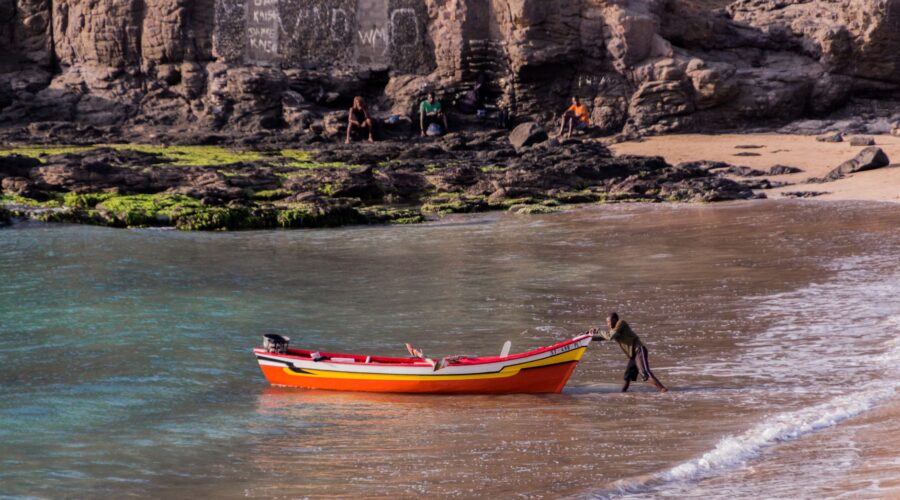
If you look closely at the colorful wooden boats (botes) lining the shores of Mindelo or Sal Rei, you will see specific markings and objects. These are not merely decorative:
- The ‘Patua’: Small pouches containing herbs, salt, or sacred verses hidden within the boat’s structure to ward off the Saka Sereia.
- Color Choice: Bright blues and greens are often used to camouflage the boat against the sea, while red accents are sometimes believed to protect against the “evil eye” (mau-olhado).
- Salt and Tobacco: In some communities, fishers still throw a pinch of salt or a small amount of tobacco into the water before casting their nets—a symbolic “payment” to the spirits for safe passage.
The Psychological Weight of the Sea
From a sociological perspective, the Saka Sereia mystery serves a vital purpose. Cape Verde is a nation defined by migration and the sea. For those who stay and work the waters, the constant threat of loss is a psychological burden. By personifying the dangers of the ocean through the figure of the mermaid, the community creates a way to process grief and explain the inexplicable.
When a seasoned fisher disappears, the community often says the mermaid “took him.” This provides a narrative framework for a tragedy that would otherwise be purely chaotic. It honors the fisher by suggesting he was chosen by a powerful force, rather than simply being a victim of bad weather.
Folklore in the Modern Age: Does the Mystery Persist?
As Cape Verde modernizes, with GPS technology and larger industrial fishing vessels, one might expect the legend of the Saka Sereia to fade. However, the mystery remains surprisingly resilient. Even among younger generations of fishers, there is a lingering hesitation to mock the old stories.
Music and literature have also played a role in keeping the myth alive. Morna and Coladeira songs often reference the sea as a woman—sometimes a mother, sometimes a lover, and sometimes a siren who calls men away from their families. The world-famous “Barefoot Diva,” Cesária Évora, sang often of the “Mar Azul” (Blue Sea) and its capacity to both give and take away life, echoing the sentiments of the Saka Sereia folklore.
Sustainable Fishing and Cultural Respect
Interestingly, the folklore of the mermaid has an unintentional environmental benefit. The belief that the sea is guarded by a sentient, vengeful spirit encourages a form of “traditional conservation.” Fishers who fear the Saka Sereia are less likely to overfish or disrespect the marine environment, believing that greed will attract the mermaid’s wrath. In this way, the myth acts as a cultural regulator for the islands’ fragile ecosystems.
Conclusion: The Eternal Call of the Atlantic
The Saka Sereia mystery is a testament to the resilience of Cape Verdean culture. It is a story of survival, a bridge between two continents, and a reflection of the profound relationship between a people and the ocean that surrounds them. To understand the fishers of Cape Verde, one must understand their rituals; and to understand their rituals, one must acknowledge the mermaid that lurks just beneath the surface of the waves.
Whether the Saka Sereia is a literal creature of the deep or a metaphor for the untamable power of nature, she remains a central figure in the Cape Verdean soul—a reminder that despite our modern advancements, the sea still holds secrets that no map can chart.
Image: Pexels – Thomas Schwaak