Navigating the Estreito de Santa Luzia: Cape Verde’s Wild Strait
In the vast expanse of the Atlantic Ocean, where the trade winds whistle through volcanic peaks, lies one of West Africa’s most enigmatic stretches of water: the Estreito de Santa Luzia. This narrow channel separates the bustling, culturally vibrant island of São Vicente from the ghostly, uninhabited silhouette of Santa Luzia. To the casual observer, it is a beautiful ribbon of turquoise and deep indigo; to the local mariner, it is a place of profound power, tactical difficulty, and ancestral taboo.
Spanning approximately 8 to 10 nautical miles, the crossing of the Estreito de Santa Luzia is not merely a physical journey from one island to another. It is a rite of passage for sailors, a sanctuary for marine life, and a living museum of Cape Verdean folklore. In this article, we dive deep into the currents, the myths, and the sheer thrill of navigating one of the most challenging channels in the Macaronesian archipelago.
The Geography of a Natural Wind Tunnel
The Estreito de Santa Luzia (The Strait of Santa Luzia) acts as a natural funnel between the windward islands of the Barlavento group. Because both São Vicente and Santa Luzia are mountainous, the Venturi effect—a phenomenon where wind speed increases as it is forced through a narrow space—is in full force here. The northeasterly trade winds, which blow consistently for much of the year, are squeezed through the strait, often reaching speeds significantly higher than in the open ocean.
This wind, combined with powerful north-south currents and shallow underwater ridges, creates a “washing machine” effect. Even on a seemingly calm day in the harbor of Mindelo, the Estreito can present standing waves and turbulent cross-seas that challenge the hulls of both traditional wooden botes and modern sailing yachts. For those navigating from Mindelo to the protected bay of Porto da Casa on Santa Luzia, the journey requires precise timing and a deep respect for the elements.
The Mystique of Santa Luzia: The Forbidden Island
To understand the allure of the crossing, one must understand the destination. Santa Luzia is the only uninhabited island in Cape Verde. While it was home to a small community of cattle herders and fishermen in the 18th and 19th centuries, the extreme lack of freshwater eventually forced a permanent evacuation. Today, it is a strictly regulated Integral Nature Reserve.
For the people of São Vicente, Santa Luzia represents a “lost world.” It sits on the horizon, a jagged, reddish-brown silhouette that changes color with the setting sun. Because it is uninhabited, it has taken on a mystical quality. It is a place of silence, where the only residents are the endangered Razon Island Larks, giant skinks, and thousands of nesting sea turtles. The act of crossing the Estreito is, for many, an act of leaving civilization behind to face the raw, unedited version of the Cape Verdean landscape.
The Taboos and Local Lore
In the seaside bars of Mindelo, veteran fishermen speak of the Estreito with a mixture of reverence and superstition. There are long-standing taboos regarding the “spirits” of the uninhabited island. Some locals believe that Santa Luzia is a place where the souls of the sea reside, and that taking anything from the island—even a stone or a piece of driftwood—will bring bad luck (or azazar) to the vessel during the return crossing.
There are also tales of phantom lights seen from the São Vicente coast, flickering on the dark shores of Santa Luzia at night. While scientists attribute these to bioluminescence or the reflection of stars on the salt flats, the local narrative leans toward the supernatural. These myths serve a practical purpose: they instill a sense of caution. The Estreito is not a place for the arrogant; it is a place where the sea remains the ultimate master.
Biodiversity: A Highway for Giants
Beyond the wind and the myths, the Estreito de Santa Luzia is a biological hotspot. The nutrient-rich currents that make navigation so difficult also make the channel a buffet for marine life. It is one of the best places in the North Atlantic to spot humpback whales during their migratory season (February to May).
Sailors making the crossing often find themselves escorted by pods of Atlantic spotted dolphins or rough-toothed dolphins. The channel is also a critical corridor for tiger sharks and hammerheads, which patrol the deep trenches between the islands. For researchers, the Estreito is a living laboratory, but for the visitor, it offers the heart-pounding thrill of seeing a whale’s fluke break the surface against the backdrop of the desolate Santa Luzia peaks.
The Thrill of the Crossing: Modern Navigation
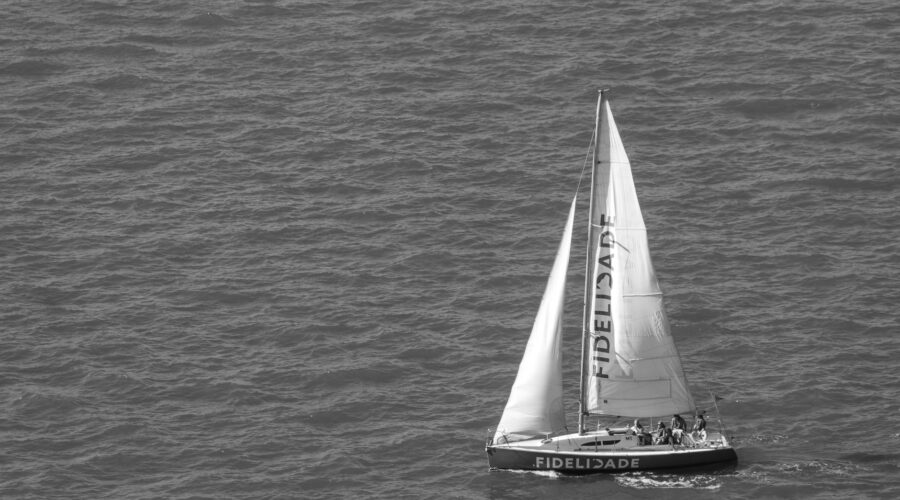
For the modern adventurer, the Estreito de Santa Luzia is a bucket-list sail. Most expeditions depart from the Mindelo Marina. The first few miles are usually smooth, sheltered by the mass of São Vicente. However, as soon as the boat clears the “Ponta do Machado,” the full force of the Atlantic hits.
Navigating the strait requires a tactical approach to “tacking” against the wind. The sea spray is constant, and the sight of the uninhabited island growing larger on the horizon is exhilarating. There is a profound sense of isolation; once you are in the middle of the Estreito, the modern world feels light-years away.
Practical Information for Travelers
- Permits: Because Santa Luzia is a Nature Reserve, you cannot simply land your boat and hike. You must obtain permission from the DNA (Direção Nacional do Ambiente) in Mindelo.
- Chartering: Local skippers in Mindelo offer day trips or overnight stays (sleeping on the boat). It is highly recommended to hire a local captain who understands the specific “moods” of the Estreito.
- Best Time to Cross: The summer months (June to August) often provide calmer winds, though the heat can be intense. The “Windy Season” (December to April) is for experienced sailors only.
Conservation and the Future
The Estreito de Santa Luzia is currently at the center of conservation efforts. Organizations like Biosfera I, based in São Vicente, work tirelessly to protect the channel from illegal fishing and to monitor the bird populations on the uninhabited island. The difficulty of the crossing has, in a way, been Santa Luzia’s greatest protector. The treacherous waters act as a natural barrier, keeping the “human footprint” at bay and allowing the island to remain one of the few pristine wildernesses left in the Atlantic.
Conclusion: A Journey of Respect
The Estreito de Santa Luzia is more than a gap on a map. It is a reminder of the power of nature and the enduring strength of Cape Verdean maritime culture. Whether you are a sailor seeking the adrenaline of the wind, a biologist tracking the path of whales, or a dreamer looking at the horizon from the shores of Mindelo, the Strait demands respect.
To cross the Estreito is to enter a space where the rules of the land no longer apply. It is a place of wind, salt, and spirits—a treacherous, beautiful bridge to the silence of Santa Luzia.
Image: Pexels – José Barbosa