Mesa de Djunta-Mó: Cape Verde’s Social Feast Etiquette
In the heart of the North Atlantic, the ten volcanic islands of Cape Verde hold secrets that transcend their lunar landscapes and morna melodies. While the archipelago is famous for its “morabeza” (hospitality), there is perhaps no greater expression of this cultural soul than the Mesa de Djunta-Mó. Translated literally as “joining hands,” Djunta-Mó is the Cape Verdean philosophy of collective labor and mutual aid. However, when the work ends and the celebration begins, the Mesa (table) becomes a sophisticated theater of social hierarchy, tradition, and symbolic order.
To the uninitiated observer, a traditional Cape Verdean feast might look like a joyous, chaotic gathering of family and friends. But look closer, and you will see a meticulous arrangement. From the placement of the elders to the distribution of the catchupa, the seating arrangements at a traditional feast are a physical map of the community’s social fabric.
The Origins of Djunta-Mó: More Than Just a Meal
To understand the table, one must understand the work. The concept of Djunta-Mó originated in the rural interior of islands like Santiago, Fogo, and Santo Antão. In a land where resources were scarce and the terrain was rugged, survival depended on the community. Whether building a house, harvesting maize, or preparing for a wedding, the village worked as one. The “repayment” for this communal labor was the feast.
The Mesa de Djunta-Mó is therefore not just a place to eat; it is a sacred space where the community’s balance is restored and recognized. It is a reward for sweat and a reinforcement of the bonds that ensure the group’s survival through the next dry season.
The Sacred Geography: Who Sits Where?
The seating at a traditional Cape Verdean feast is rarely accidental. It follows an ancestral logic that prioritizes age, status, and the “Owners of the Feast” (Dona da Casa or O Dono da Festa).
The Head of the Table: The Elders and Patriarchs
In Cape Verdean culture, age is synonymous with wisdom and authority. The Cabeceira (the head of the table) is strictly reserved for the eldest male or female members of the family or the most respected figures in the village. This is the seat of honor. By placing the elders at the head, the community acknowledges its history and lineage. It is common to see these patriarchs and matriarchs served first, often with the “prime cuts” of the meat or the most flavorful portions of the stew.
The Flanks: Guests of Honor and Religious Figures
Flanking the elders are usually the guests of honor. This might include a visiting relative from the diaspora, the local priest, or a community leader. Their proximity to the head of the table signifies their importance to the family unit. In many traditional settings, there is a clear distinction between the “inner circle” at the main table and the peripheral seating areas for younger men and distant neighbors.
The Role of Women: The Silent Architects
A fascinating, if traditional, dynamic of the Mesa de Djunta-Mó involves the role of women. While the matriarchs often hold the seat of honor alongside the patriarchs, the younger women and the “mothers of the kitchen” are frequently absent from the main seating during the peak of the meal. They are the architects of the feast, managing the flow of food and drink. In many rural communities, women eat in a separate, secondary seating arrangement or after the main service is complete—a practice that is slowly changing in urban centers but remains a hallmark of traditional rural etiquette.
Symbolism in the Spread: Decoding the Menu
The food served at a Djunta-Mó table is as symbolic as the seating. Each dish tells a story of the island’s history, blending Portuguese influence with African agricultural staples.
- Catchupa Rica: The national dish, a slow-cooked stew of corn, beans, and various meats. The richness of the catchupa served at a feast (often featuring more meat and sausage than the daily version) is a direct reflection of the host’s generosity and the success of the collective labor.
- Xerém: Ground corn that serves as the foundation for many feasts, symbolizing the earth and the harvest.
- Grogue and Pontche: The local sugarcane spirit is the “oil” that lubricates the social machinery. It is used for toasts, which are essential rituals at the table, often led by the elder at the head.
The Ritual of the First Serving
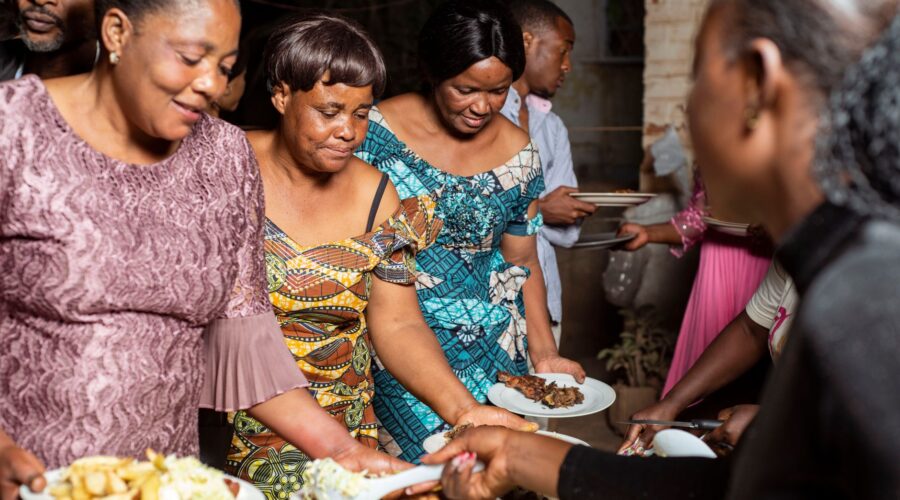
Etiquette at the Mesa de Djunta-Mó dictates that no one begins eating until a blessing or a word of thanks is offered, typically by the most senior person present. The act of serving is itself a performance. The younger generation or specific designated “servers” move with a quiet efficiency, ensuring that the plates of the elders are never empty. This reinforces the hierarchy of care: those who have cared for the community for decades are now cared for by the youth.
Modernity and the Diaspora: Is the Tradition Fading?
As Cape Verdeans have migrated across the globe—to Boston, Lisbon, Paris, and Rotterdam—the Mesa de Djunta-Mó has traveled with them. However, the strictness of the hierarchy has softened in the diaspora. In a suburban home in Massachusetts, the “head of the table” might be a grandmother, but the seating is often more fluid, reflecting a more egalitarian Western influence.
Yet, during the great Festas de Romaria (Sanctuary Festivals) back in Cape Verde—such as the feast of São Filipe in Fogo or Santo António in Brava—the traditional hierarchy returns with full force. For a few days, the modern world recedes, and the ancient social codes of the islands take over. The table becomes a bridge between the past and the present.
Conclusion: The Table as a Microcosm of Society
The Mesa de Djunta-Mó is far more than a furniture piece or a mealtime gathering. It is a living map of Cape Verdean social values. It teaches the young to respect their elders, it honors the labor of the community, and it provides a sense of belonging in a world that is often fragmented. To be invited to sit at such a table is not just an invitation to eat; it is an invitation to witness the enduring strength of the Cape Verdean spirit.
For travelers and researchers visiting the islands, understanding these nuances is key to appreciating the depth of Morabeza. The next time you find yourself at a Cape Verdean feast, look at the seating, listen to the toasts, and observe the flow of the meal. You aren’t just seeing a dinner; you are seeing the heartbeat of a culture.
Image: Pexels – Crispin Monga