Cape Verde’s Seed Bank: Protecting Food Sovereignty
In the heart of the Santiago Island interior, nestled within the verdant yet rugged valley of São Jorge dos Órgãos, lies a silent fortress. It does not guard gold or currency, but something far more valuable to the survival of the Cape Verdean people: genetic memory. The Banco de Sementes (National Seed Bank), managed by the National Institute for Agricultural Research and Development (INIA), is the archipelago’s frontline defense against climate change, genetic erosion, and food insecurity.
A Fortress Against an Arid Reality
Cape Verde is an archipelago defined by its resilience. Located in the Sahelian belt, the country faces chronic water scarcity, erratic rainfall, and poor soil quality. For centuries, Cape Verdean farmers have adapted to these “dry-land” conditions, developing unique varieties of maize, beans, and tubers that can survive on minimal moisture. However, as global temperatures rise and weather patterns become increasingly unpredictable, these ancestral crops are at risk of disappearing.
The Seed Bank of São Jorge was established to ensure that these localized varieties—evolved over 500 years of Atlantic history—do not vanish. By preserving the genetic material of indigenous and naturalized plants, the bank provides a safety net for a nation that imports over 80% of its food. It is not just a scientific facility; it is a repository of Cape Verdean sovereignty.
The Science of Preservation
Walking through the facility in São Jorge, one encounters a sophisticated system of collection, classification, and storage. The process begins in the fields, where technicians work with local farmers across all ten islands to identify “landraces”—domesticated plant varieties that have adapted to the specific microclimates of places like the high peaks of Santo Antão or the arid plains of Maio.
The Collection Process
Once seeds reach the bank, they undergo a rigorous protocol:
- Cleaning and Selection: Seeds are meticulously cleaned to remove debris and damaged specimens.
- Dehydration: Moisture is the enemy of long-term storage. Seeds are dried to a specific water content (usually between 5% and 7%) to slow down their biological clock.
- Cold Storage: The seeds are sealed in airtight containers and stored in specialized chambers. For short-to-medium-term use, they are kept at 4°C. For long-term “base collection” conservation, temperatures drop to -20°C.
At these sub-zero temperatures, seeds can remain viable for decades, acting as a “backup drive” for the nation’s agriculture. If a devastating drought or a new pest were to wipe out a specific variety of feijão pedra (stone bean) in the wild, the bank in São Jorge could provide the genetic material to restart production.
The Quest for Food Sovereignty
Food security is defined as having access to enough food; food sovereignty is the right of a people to define their own agricultural and food systems. For Cape Verde, food sovereignty is inextricably linked to the Seed Bank.
By focusing on local varieties rather than imported commercial seeds, the bank empowers farmers. Commercial seeds often require high amounts of chemical fertilizers and consistent irrigation—luxuries that Cape Verdean farmers rarely have. In contrast, the seeds stored in São Jorge are “rugged.” They are the descendants of crops that survived the Great Famines of the 1940s. They are naturally resistant to the heat and require less water.
The bank currently houses hundreds of accessions, with a primary focus on the “Cape Verdean diet staples”:
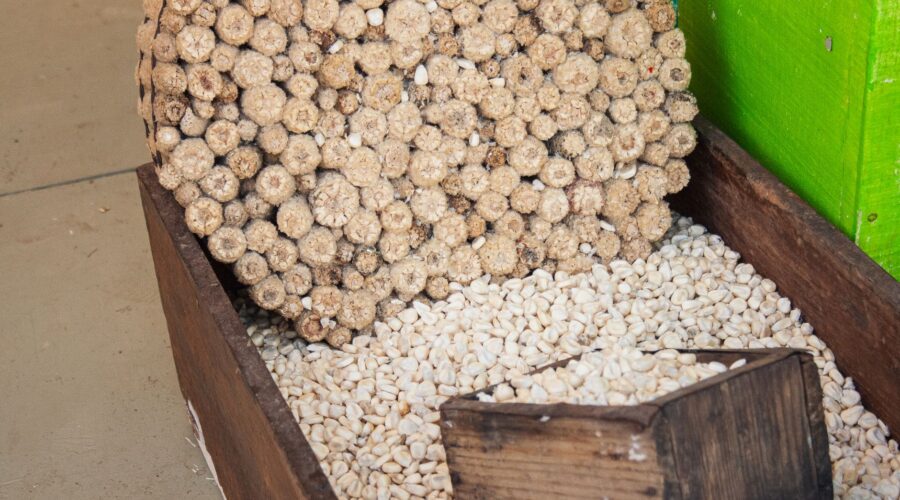
- Maize (Milho): The backbone of the national dish, cachupa. The bank preserves varieties that mature quickly, catching the short “azágua” (rainy season).
- Beans (Feijões): Including feijão congo, bonlonha, and sapatinha, which are vital protein sources.
- Tubers: Varieties of sweet potato and cassava that are resilient to soil salinity.
Cultural Heritage in a Jar
Beyond the science, there is a profound cultural element to the work in São Jorge. Every seed variety carries a story. Some were brought by Portuguese settlers from the Mediterranean; others crossed the Atlantic from the Americas during the “Columbian Exchange,” while many arrived from West Africa. Over centuries, these plants “became” Cape Verdean.
The loss of a specific bean variety isn’t just a biological loss; it’s a loss of culinary heritage and traditional knowledge. The Seed Bank works to keep these traditions alive by ensuring that the ingredients for traditional recipes remain available to future generations, regardless of the environmental pressures of the 21st century.
Challenges: Funding and Climate Change
Maintaining a national seed bank in a developing SIDS (Small Island Developing State) is no easy feat. The facility requires constant electricity for refrigeration—a challenge in a country where energy costs are high. Furthermore, the bank must deal with the “aging” of its collection. Every few years, a portion of the seeds must be planted out (regenerated) to produce fresh, viable seeds, which requires land, water, and labor.
International cooperation has been vital. Partnerships with the Global Crop Diversity Trust and the Millennium Seed Bank at Kew Gardens have provided technical training and equipment. Additionally, Cape Verde sends duplicates of its most precious seeds to the Svalbard Global Seed Vault in Norway—the “Doomsday Vault”—ensuring that even if a catastrophic event hit the islands, the genetic blueprint of Cape Verdean life would survive.
The Future: Biotechnology and Innovation
The National Institute for Agricultural Research and Development (INIA) is not just looking backward. The Seed Bank is a foundation for future innovation. Scientists are using the stored genetic material to breed new varieties that combine the hardiness of traditional crops with higher yields.
As Cape Verde leans into “Blue-Green” economy strategies, the Seed Bank of São Jorge is evolving. There is an increasing focus on preserving endemic flora—plants that grow nowhere else on Earth—many of which have medicinal properties or could be used for reforestation efforts to halt the desertification that threatens the islands.
Conclusion: A Legacy for the Future
The Banco de Sementes of São Jorge dos Órgãos is a testament to the Cape Verdean spirit of morabeza and resiliência. In an era where the global climate is in flux, this facility ensures that the country is not entirely at the mercy of international markets or shifting weather patterns.
By guarding these tiny biological treasures, Cape Verde is protecting its past and planting the seeds of its future. For the traveler visiting the lush valley of São Jorge, the bank may look like a simple office building, but inside, it holds the very code of survival for an entire nation.
Quick Facts for Visitors & Researchers:
- Location: São Jorge dos Órgãos, Santiago Island (Approx. 45 minutes from Praia).
- Management: INIA (Instituto Nacional de Investigação e Desenvolvimento Agrário).
- Can you visit? While it is a working research facility, educational tours can often be arranged through the INIA headquarters. The surrounding botanical garden is also a must-see for those interested in Cape Verdean flora.
Image: Pexels – Noemí Jiménez