Cape Verde Unveils €36M Blue and Green Economy Initiative
Cape Verde has officially launched a 36-million-euro initiative designed to revolutionize the nation’s relationship with its environment. The five-year project, “Accelerating Cape Verde’s Transition to a Blue and Green Economy,” aims to protect the archipelago’s fragile natural resources while creating new, sustainable income streams for local communities across four islands.
A Dual Approach to Sustainability
The project focuses on the “blue economy”—the sustainable use of ocean resources for economic growth—and the “green economy,” which emphasizes resource efficiency and social well-being. By integrating these two models, the initiative seeks to bridge the gap between biodiversity conservation and economic development.
Kátia Neves, program manager for the Food and Agriculture Organization of the United Nations (FAO), outlined the practical scope of the investment. “In practice, this means investing in soil and water conservation, agroecological transition, fisheries co-management, habitat restoration, and the enhancement of ecosystem services,” Neves explained.
Empowering Communities and Businesses
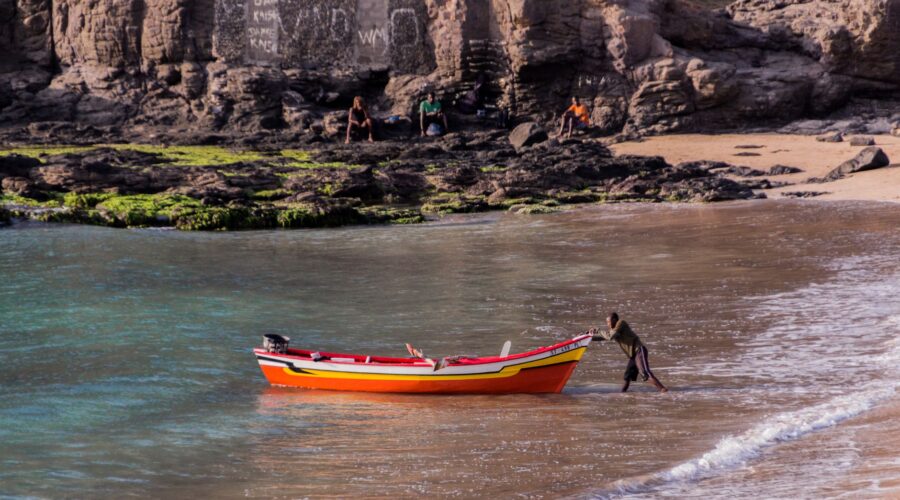
The initiative targets fishers, agricultural workers, and small-scale entrepreneurs, with a specific focus on women in the fishing industry. By strengthening value chains in sustainable agriculture, nature tourism, and fisheries, the project aims to lift families out of poverty while safeguarding the environment.
A critical component of the plan is financial accessibility. The project includes mechanisms to help community associations and small-to-medium enterprises (SMEs) secure investments. Additionally, national microfinance institutions will receive training to ensure that the project’s impact continues long after its initial five-year run.
Cracking Down on Destructive Sand Mining
Alongside the green-blue transition, the Cape Verdean government is tackling the environmental crisis caused by sand mining. Carlos Varela, Minister of Environment, Climate Action, and Energy, warned that the removal of sand from beaches causes “irreversible” damage, leading to coastal erosion and habitat loss.
To combat this, the government is developing a national program to restrict mining and provide alternative livelihoods for families currently dependent on the trade. Varela noted that the state aims to pivot toward mechanical sand production through rock crushing, inviting private investment to modernize the sector.
A Model for the Future
Funded by the Global Environment Facility (GEF) and implemented by the FAO, the project will initially serve as a model for four islands. However, officials hope the success of these interventions will provide a blueprint for the entire archipelago, ensuring a resilient and prosperous future for all of Cape Verde.
Image: Pexels – Thomas Schwaak