Cape Verde’s Unique Volcanic Geochemistry & Geology
Rising from the depths of the central Atlantic Ocean, approximately 570 kilometers off the coast of West Africa, lies an archipelago that serves as a natural laboratory for geologists. Cape Verde (officially Cabo Verde) is not just a destination of pristine beaches and vibrant Creole culture; it is a geological marvel. Defined by scientists as a Soda-Alkaline Petrographic Province, the islands offer a window into the powerful subterranean forces that shape our planet.
The Birth of an Archipelago: 50 Million Years in the Making
The story of Cape Verde’s unique geochemistry began during the Eocene epoch, roughly 40 to 50 million years ago. While the islands we see today range in age from 8 million years in the west (Brava and Santo Antão) to 20 million years in the east (Sal and Maio), the underlying structures are far older. Magnetic anomalies in the surrounding seafloor suggest that the foundations of the archipelago date back a staggering 125 to 150 million years.
Geologically, the islands sit atop the Cape Verde Rise, one of the largest bathymetric swells in the world’s oceans. This massive protuberance rises 2.2 kilometers from the ocean floor, covering a semi-circular region of 1,200 square kilometers. This “bulge” in the Earth’s crust is the stage upon which the soda-alkaline drama unfolds.
What is a Soda-Alkaline Petrographic Province?
To the layperson, “soda-alkaline petrographic province” sounds like a mouthful of academic jargon. However, it describes a very specific and rare chemical signature found in the islands’ rocks. Unlike the “tholeiitic” basalts that make up the majority of the ocean floor, the volcanic rocks in Cape Verde are distinctly basic and alkaline.
In petrology, an alkaline province is characterized by rocks rich in alkali metals—specifically sodium (soda) and potassium. In Cape Verde, the volcanic and plutonic rocks show a high concentration of sodium-bearing minerals. This geochemical “fingerprint” is similar to other Macaronesian islands (like the Canaries and the Azores) but possesses its own unique Cape Verdean variations. The presence of these minerals indicates that the magma originated from deep within the Earth’s mantle, likely from a “hotspot” that has remained stationary while the African tectonic plate moved slowly over it.
The Role of Carbonatites and Rare Rocks
One of the most fascinating aspects of Cape Verde’s geochemistry is the presence of carbonatites—rare volcanic rocks that are composed of more than 50% carbonate minerals. While most volcanoes spew silicate-rich lava (molten rock), carbonatite volcanism is exceptionally rare globally. These rocks provide scientists with invaluable data about the composition of the Earth’s mantle and the volatile gases trapped beneath the crust.
Fogo: The Living Laboratory
While many of the islands, such as Sal and Maio, have long since ceased their volcanic activity—allowing erosion to create flat, sandy landscapes and extensive salt flats—the island of Fogo remains a potent reminder of the archipelago’s fiery origins. Fogo, which literally means “Fire,” is home to Pico do Fogo, the largest active volcano in the region.
The geochemistry of Fogo is particularly intense. The island is dominated by a massive eight-kilometer-diameter caldera. This depression was formed by subsidence—the ground collapsing into a partially emptied magma chamber roughly 8 kilometers deep. The most recent eruption in 2014 showcased the classic alkaline basaltic flows that define the province, sending streams of molten rock across the Chã das Caldeiras and reminding the world that the geological evolution of Cape Verde is far from over.
Geology Meets Geography: A Diverse Landscape
The soda-alkaline nature of the rocks has directly influenced the archipelago’s diverse physical geography. The islands are spatially divided into two groups:
- The Barlavento (Windward) Islands: Including Santo Antão, São Vicente, and Sal.
- The Sotavento (Leeward) Islands: Including Santiago, Fogo, and Maio.
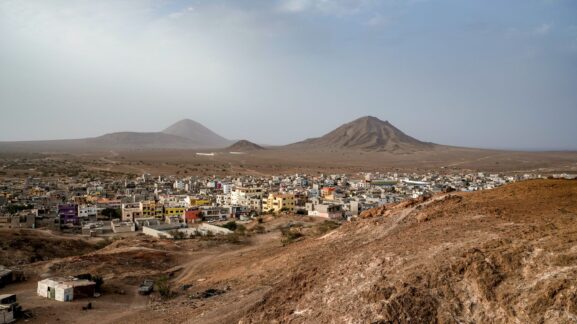
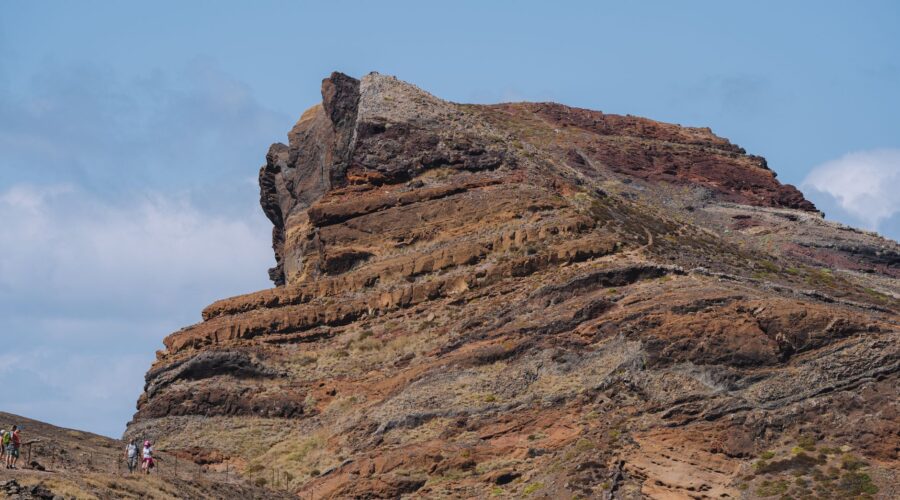
The older eastern islands (Sal, Boa Vista, and Maio) are flat and arid, their volcanic peaks worn down by millions of years of Atlantic winds. In contrast, the younger islands like Santiago and Santo Antão feature towering mountains and jagged cliffs. On these islands, the alkaline soil, combined with orographic rainfall (moisture trapped by high peaks), allows for the growth of lush “laurel forests” and fertile valleys where sugarcane and coffee thrive.
The Human Connection to the Stone
The unique geology of Cape Verde has shaped its history and economy. The lack of traditional mineral resources like gold or diamonds led the early Portuguese settlers to look toward other geological gifts. The extensive salt flats on Sal and Maio became the backbone of a thriving salt trade in the 18th and 19th centuries, giving the island of Sal its name.
Furthermore, the islands’ strategic position in the mid-Atlantic—a result of their volcanic formation—made them a vital stopping point for explorers and scientists. Even Charles Darwin made Cape Verde his first stop during the voyage of the HMS Beagle in 1832. He spent his time on the island of Santiago, fascinated by the white bands of limestone sandwiched between volcanic rocks, which helped him formulate his early theories on geological uplift.
Preserving a Geological Heritage
Today, Cape Verde is recognized as a “success story” in Africa, known for its stable democracy and growing tourism sector. However, the very geology that makes the islands beautiful also makes them vulnerable. The archipelago is on the frontlines of the climate crisis, with rising sea levels threatening its coastal communities.
In a forward-thinking move, the Cape Verdean government has embraced its natural environment. The country is a leader in renewable energy, aiming to source 50% of its power from renewable sources by 2030. In 2023, a landmark “debt-for-nature” swap with Portugal ensured that millions of euros would be invested in environmental and climate projects, protecting the unique biodiversity and geological integrity of the islands.
Conclusion
The Soda-Alkaline Petrographic Province of Cape Verde is more than just a scientific classification; it is the DNA of the archipelago. From the black sands of Fogo to the salt crusts of Sal, the geochemistry of these islands tells a story of deep-mantle plumes, tectonic shifts, and the relentless power of the Atlantic. For the traveler, the geologist, or the curious mind, Cape Verde remains one of the most compelling places on Earth to witness the ongoing dialogue between the fire of the Earth and the waters of the ocean.
Image: Pexels – Diogo Miranda