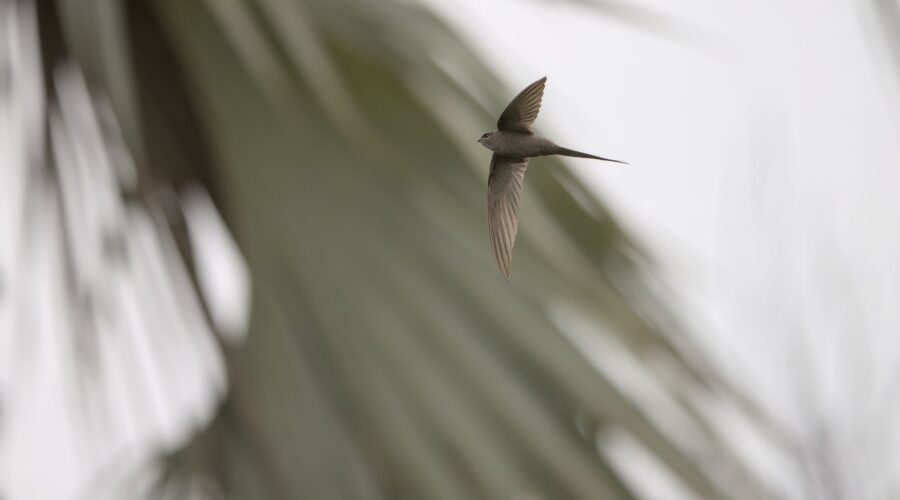
Alexander’s Swift: Cape Verde’s Endemic Aerial Acrobat
High above the jagged volcanic peaks of Santo Antão and the arid, sun-drenched plains of Santiago, a small, dark blur streaks across the sky with unmatched agility. This is Alexander’s Swift (Apus alexandri), a bird that embodies the rugged, resilient spirit of the Cape Verde archipelago. As one of the few avian species found nowhere else on Earth, this “aerial acrobat” is a living testament to the unique evolutionary history of this mid-Atlantic nation.
An Island Specialist: What is Alexander’s Swift?
Alexander’s Swift is a small bird in the swift family (Apodidae). To the untrained eye, it may resemble the Common Swift seen across Europe, but it is smaller, darker, and carries a distinct evolutionary signature. Named after the British ornithologist Boyd Alexander, who explored the islands in the late 19th century, this species has adapted perfectly to the Macaronesian environment.
Measuring roughly 13 centimeters in length, the swift is characterized by its slender, cigar-shaped body and long, scythe-like wings. Its plumage is a smoky dark brown, almost black, with a slightly paler throat patch. In flight, it is a master of the air, rarely touching the ground except to nest in the crevices of Cape Verde’s dramatic cliffs and old stone buildings.
The Geography of Survival
Cape Verde, or Cabo Verde, is a horseshoe-shaped cluster of ten volcanic islands located approximately 570 kilometers off the coast of West Africa. The archipelago is divided into two groups: the Barlavento (windward) islands like Santo Antão and Sal, and the Sotavento (leeward) islands, including the capital Santiago and the volcanic Fogo.
Alexander’s Swift can be found across most of these islands, thriving in a variety of microclimates. While Sal and Boa Vista are notoriously flat and desert-like, receiving less than 250 mm of annual rainfall, islands like Santiago and Santo Antão offer towering mountains and humid “monsoon forests.” The swift is equally at home darting through the mist-covered peaks of the interior as it is hunting insects over the arid coastal salt flats.
A Life in Motion
Like all swifts, Apus alexandri is an insectivore that feeds on the wing. They are often seen in small, screaming parties, wheeling and diving at high speeds to catch “aerial plankton”—small flying insects and spiders carried by the wind. Because Cape Verde is part of the Sahelian semi-arid belt, these birds have become masters of opportunistic hunting, following the sporadic rains that fall between August and October to find concentrated pockets of prey.
Cultural and Ecological Significance
In a country where 95% of the population speaks Cape Verdean Creole (Crioulo), the swift is a familiar part of the local landscape. It shares the skies with other endemic species like the Iago sparrow and the Raso lark. However, the swift’s presence in urban centers like Praia and Mindelo makes it a bridge between the wild volcanic nature of the islands and the daily lives of the 530,000 residents.
Historically, Cape Verde was uninhabited until the 15th century, when Portuguese explorers discovered the islands. Since then, the landscape has changed significantly due to human settlement, agriculture, and the introduction of non-native species. Despite these changes, Alexander’s Swift has remained a constant, utilizing the stone walls of historic settlements like Cidade Velha (the first permanent European settlement in the tropics) as nesting sites.
Threats and Conservation: The Challenge of Climate Change
While Alexander’s Swift is currently more stable than some of Cape Verde’s other endemics, it faces modern challenges. The archipelago is on the frontlines of the global climate crisis. As a nation highly susceptible to flooding and changing weather patterns, Cape Verde is seeing shifts in the “Cape Verde-type hurricanes” that form near the islands.
Changes in humidity and rainfall patterns can affect the abundance of the insects the swifts rely on. Furthermore, habitat loss due to tourism development and urban expansion requires careful management. Fortunately, the government of Cabo Verde has become a leader in environmental policy. In 2023, the country entered a pioneering “debt-for-nature” swap with Portugal, investing €140 million into environmental and climate projects to protect its unique biodiversity.
Tips for Birdwatchers: How to Spot the Swift
If you are planning a trip to this Macaronesian paradise, here is how you can observe Alexander’s Swift:
- Location: While they are found on almost all islands, the mountains of Santo Antão and Santiago offer the most dramatic viewing opportunities against the backdrop of volcanic peaks.
- Timing: They are resident year-round, but their activity often peaks during the late afternoon when the air cools and insects are most active.
- Identification: Look for the “screaming” flight calls. Their flight is more fluttery than the larger Common Swift, fitting for their smaller size.
- Coastal vs. Mountain: In the drier islands like Sal, look for them near permanent water sources or greenery where insects congregate.
Conclusion
Alexander’s Swift is more than just a bird; it is a symbol of Cape Verde’s unique position in the Atlantic. It has survived the volcanic eruptions of Fogo, the decline of the transatlantic trade routes that once defined the islands’ economy, and the transition to a modern, democratic republic. To watch these birds dive through the Atlantic mist is to witness a specialized piece of evolution that exists nowhere else on the planet—a true aerial treasure of the “Green Cape.”
Image: Pexels – Derek Keats