Agriculture & Fishing in Cape Verde: Soil, Sea, and Survival
In the middle of the Atlantic Ocean, the ten volcanic islands of Cape Verde (Cabo Verde) rise dramatically from the sea. While the nation has gained international fame for its soulful morna music and burgeoning tourism industry, the traditional pillars of its economy and culture remain rooted in the earth and the ocean. Agriculture and fishing are not just industries in Cape Verde; they are the historical lifelines that have sustained the archipelago for centuries.
The Paradox of Cape Verdean Agriculture
Agriculture in Cape Verde is a story of resilience against improbable odds. Only about 10% of the country’s land is considered arable. The archipelago faces a harsh “Sahelian” climate, characterized by chronic droughts, erratic rainfall, and steep, volcanic terrain that makes large-scale mechanized farming nearly impossible.
Despite these challenges, agriculture remains a vital social sector, employing a significant portion of the rural population. The industry is defined by two distinct landscapes: the rain-fed highlands and the irrigated valleys.
Traditional Crops and Subsistence Farming
For the average Cape Verdean farmer, life revolves around “sequeiro” (rain-fed) farming. The staple of the national diet is maize (corn), which is grown alongside various types of beans (pedra, sapatinha, and congo). When the summer rains—locally called as águas—arrive, the hillsides of islands like Santiago, Santo Antão, and Fogo transform into vibrant green terraces.
The iconic Cape Verdean dish, Cachupa, is a direct reflection of this agricultural output. It is a slow-cooked stew of corn, beans, cassava, sweet potatoes, and whatever meat or fish is available. This dish is more than food; it is a symbol of survival and the ability to create something rich from humble ingredients.
The Lush Valleys and Export Potential
In contrast to the dry hills, the deep valleys (ribeiras) of Santo Antão and Santiago are lush tropical oases. Here, groundwater allows for the cultivation of bananas, papayas, mangoes, and sugarcane. Sugarcane is particularly important as it is the primary ingredient for Grogue, the national spirit. The artisanal distillation of Grogue is a major rural enterprise, with the best varieties coming from the sun-drenched valleys of Santo Antão.
Fogo Island holds a unique niche with its volcanic soil, which produces high-quality coffee and the famous Chã das Caldeiras wine. Grown inside a volcanic crater, these vines benefit from the mineral-rich ash, producing a bold flavor that is increasingly sought after by European connoisseurs.
The Blue Frontier: Fishing in Cape Verde
If the land is Cape Verde’s challenge, the sea is its greatest opportunity. With an Exclusive Economic Zone (EEZ) covering nearly 800,000 square kilometers—about 200 times its land area—Cape Verde sits in a biologically productive zone where cold and warm currents meet.
Artisanal Fishing: The Heart of the Community
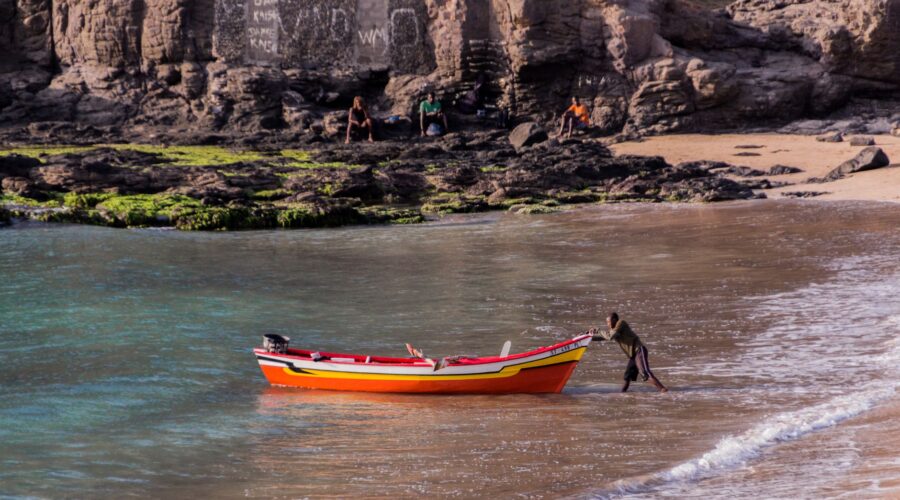
Walk onto any beach in Mindelo, Tarrafal, or Santa Maria at 11:00 AM, and you will witness the heartbeat of the islands. Brightly painted wooden boats, known as botes, return to shore laden with the morning’s catch. Artisanal fishing is the backbone of local food security, providing fresh protein to almost every household.
The variety of species is staggering. From the ubiquitous Chicharro (mackerel) and Garoupa (grouper) to the highly prized Lagosta (spiny lobster), the sea provides a bounty that supports thousands of families. The role of the “Peixeira” (fishmonger) is culturally significant; these women are the primary distributors, carrying heavy basins of fish on their heads to markets and neighborhoods, negotiating prices with legendary wit and speed.
Industrial Fishing and Export
Beyond the shore, Cape Verde is a major hub for migratory tuna. Species like Yellowfin, Bigeye, and Skipjack pass through these waters. The port of Mindelo on São Vicente is one of the most important fishing hubs in the Mid-Atlantic, offering refueling, cold storage, and processing facilities for international fleets.
Canned tuna is one of Cape Verde’s few significant physical exports. The industry is currently undergoing a modernization phase, with the government seeking to move beyond simply selling fishing licenses to foreign vessels and instead focusing on value-added processing within the islands.
Challenges: Climate Change and Sustainability
Both sectors face existential threats. For agriculture, the primary enemy is desertification. Cape Verde has endured multi-year droughts that have decimated livestock and forced a heavy reliance on imported food (roughly 80% of the country’s food is imported).
For fishing, the threat is two-fold: overfishing by large international industrial trawlers and the rising temperature of the oceans. Illegal, Unreported, and Unregulated (IUU) fishing in West African waters puts immense pressure on local stocks, making it harder for artisanal fishermen to find catch near the shore.
The Future: Innovation and “Blue Growth”
The Cape Verdean government and international partners are turning to technology to solve these ancient problems. In agriculture, there is a massive push toward hydroponics and drip irrigation. Drip irrigation, in particular, has revolutionized farming in Santiago, allowing farmers to grow vegetables year-round with minimal water waste. Desalination technology is also being explored to provide irrigation water, though energy costs remain a hurdle.
In the maritime sector, the “Blue Economy” (Economia Azul) is the new strategic frontier. This involves not just catching fish, but sustainable aquaculture, marine biotechnology, and maritime logistics. The goal is to transform Cape Verde into a “Mid-Atlantic Special Maritime Economic Zone.”
Conclusion: A Culture Tied to the Elements
To understand Cape Verde, one must understand its relationship with the soil and the sea. The grit of the farmer terrace-farming a volcanic peak and the bravery of the fisherman navigating the Atlantic swells are the true characteristics of the Cape Verdean spirit. While the country modernizes and leans into tourism and digital services, agriculture and fishing remain the cultural anchors that ensure the islands remain self-sufficient, resilient, and uniquely their own.
Quick Facts for Travelers:
- Best place to see traditional farming: The Paul Valley in Santo Antão.
- Best place to see the fish market: The Mercado de Peixe in Mindelo, São Vicente.
- Must-try local product: Fogo Coffee (Café do Fogo) and Grogue from Santo Antão.
- Sustainability Tip: When visiting, choose locally caught fish and seasonal fruits to support the small-scale producers who are the guardians of these islands.
Image: Pexels – Thomas Schwaak