Uril: The Ancient Soul of Cape Verdean Strategy & Culture
In the quiet shade of an acacia tree in Praia or along the windy cobblestone alleys of Mindelo, a rhythmic clicking sound often punctuates the air. It is the sound of gray-green seeds dropping into wooden pits—the sound of Uril. More than just a pastime, Uril (also known as Ouril) is the heartbeat of Cape Verdean social life. It is a game of deep mathematical strategy, historical weight, and communal bonding that has survived centuries of Atlantic history.
The African Genesis: From Mancala to the Islands
To understand Uril is to understand the broader family of games known as Mancala. Derived from the Arabic word naqala (to move), Mancala is one of the oldest board game families in the world, with roots stretching back thousands of years across the African continent and parts of the Middle East. Archaeological evidence in Ethiopia and Egypt suggests that variations of these “pit and pebble” games existed as early as the 6th and 7th centuries AD.
Uril arrived in Cape Verde via the tragic currents of the transatlantic slave trade. Enslaved West Africans brought the game’s logic and rules in their minds, carving boards from whatever wood was available or simply digging holes in the volcanic earth. Over time, the game became uniquely Cape Verdean, evolving into a symbol of resistance and cultural preservation. While it shares similarities with the Ghanaian Oware or the Nigerian Ayo, the Cape Verdean Uril has its own specific cadence and social etiquette.
The Anatomy of the Game: Seeds and Strategy
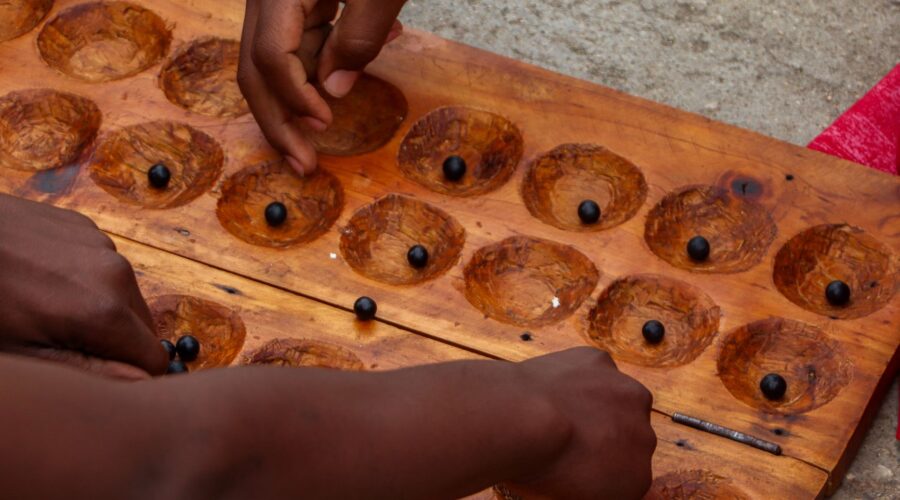
The physical setup of Uril is deceptively simple. The board, usually carved from mahogany or pine, consists of two rows of six pits (houses). Each player controls the row closest to them. The game is played with 48 seeds, four in each pit. In Cape Verde, the traditional seeds used are from the Caesalpinia bonduc plant—small, smooth, gray seeds locally known as carrapatos or grão de uril.
The Rules of Engagement
Uril is a game of “sowing” and “reaping.” The objective is to capture more than 24 seeds. Players take turns picking up all the seeds from one of their pits and distributing them one by one in a counter-clockwise direction into the subsequent pits. If the last seed dropped lands in an opponent’s pit and brings the total count in that pit to two or three, those seeds are captured. If the preceding pits also contain two or three seeds, they are captured as well.
However, there is a fundamental rule of “Grandmother’s Mercy” or social responsibility: a player must never “starve” their opponent. If an opponent has no seeds in their pits, the player must, if possible, make a move that provides the opponent with seeds to keep the game alive. This reflects the deeply ingrained Cape Verdean value of Morabeza—a spirit of hospitality and mutual respect.
The Social Logic: More Than Just a Win
In Cape Verde, Uril is rarely played in isolation. It is a spectator sport. A game between two masters will inevitably attract a crowd of observers who comment, jeer, and offer unsolicited advice. This “social logic” is what differentiates Uril from Western games like Chess.
While Chess is often played in silence, Uril is loud. Players use psychological tactics, known as “mouth-fighting,” to distract their opponents. They might slam the seeds down with a flourish to demonstrate confidence or mock a “short-sighted” move. Despite the intensity, the game almost always ends in laughter and a handshake, reinforcing the social fabric of the neighborhood.
Gender and the Changing Landscape
Historically, Uril was predominantly a game for men, played in public squares, taverns, and “Casas de Pasto.” Women often played at home or in more private settings. However, in the modern era, these boundaries are dissolving. Today, you will find women competing in national tournaments and young children learning the game in schools as a way to sharpen their mental arithmetic and concentration skills.
Uril in the Modern Era: Preservation and Competition
As digital entertainment rises, there were fears that Uril might fade into obscurity. However, Cape Verde has taken significant steps to institutionalize the game. The National Uril Championship is a major event, drawing the best players from every island—from the mountains of Santo Antão to the plains of Boavista.
The game has also found a home in the digital world. Several mobile apps now allow the Cape Verdean diaspora in Lisbon, Boston, and Rotterdam to play Uril against opponents worldwide. Yet, for purists, the digital version lacks the sensory experience: the weight of the mahogany board, the smooth texture of the seeds, and the lively banter of the local praça (square).
Why Uril Matters for Travelers
For a tourist visiting Cape Verde, Uril offers a unique window into the local soul. If you see a game in progress, it is perfectly acceptable to stand and watch. If you show a genuine interest, locals are often more than happy to teach you the basics. Learning Uril is perhaps the fastest way to earn the respect of the locals; it shows a willingness to engage with the culture beyond the beach resorts.
Interesting Facts About Uril:
- Mathematical Depth: Computer scientists have studied Uril-style games because of their complexity. The number of possible positions is astronomical, requiring players to think several moves ahead.
- The Seeds: The seeds of the Caesalpinia bonduc are extremely durable and can float across oceans, which is why the plant is found on many tropical coasts.
- Global Names: While called Uril in Cape Verde, the game is known as Warri in the Caribbean, reflecting the shared heritage of the African diaspora.
Conclusion: The Seed of Cape Verdean Identity
The Jogo do Uril is not merely a relic of the past; it is a living, breathing expression of Cape Verdean identity. It bridges the gap between the islands’ African roots and their contemporary Atlantic reality. In the clicking of the seeds, one hears the echoes of ancestors and the laughter of the future generation. Whether played for a bottle of grogue or simply for bragging rights, Uril remains the ultimate symbol of Cape Verdean intelligence, resilience, and community.
Image: Pexels – Omar Photographer