The Bote Painters of Mindelo: Cape Verde’s Geometric Boat Art
In the crescent-shaped harbor of Porto Grande, set against the jagged volcanic backdrop of São Vicente, lies one of Cape Verde’s most enduring and visually striking spectacles. It isn’t the colonial architecture or the bustling fish market that first captures the eye, but the fleet of traditional wooden fishing boats—known locally as botes—bobbing in the turquoise water. These vessels are more than mere tools of trade; they are floating canvases of geometric precision and deep-seated maritime superstition.
The “Bote” painters of Mindelo are the unsung custodians of a visual language that has remained largely unchanged for generations. In a city often dubbed the “Cultural Capital of Cape Verde,” these craftsmen practice a form of folk art that blends mathematical symmetry with spiritual protection, ensuring that every time a fisherman leaves the shore, he carries the identity and the prayers of his community with him.
The Anatomy of a Mindelo Bote
To understand the art, one must first understand the vessel. Unlike the larger industrial trawlers, the bote is a sturdy, open-decked wooden boat, typically powered by oars or small outboard motors. They are built to withstand the temperamental Atlantic swells that surge between the islands of São Vicente and Santo Antão.
The painting process begins long before the brush touches the wood. A bote must be caulked and primed, usually with a thick layer of white or gray base. It is only then that the “Master Painter” is called upon. These painters rarely use stencils or digital designs; their tools are simple: a string line, a steady hand, and an encyclopedic knowledge of traditional patterns passed down from father to son.
The Geometry of Survival
The most striking feature of a Mindelo fishing boat is its geometric rigor. The hulls are characterized by sharp, clean lines that follow the curvature of the boat, creating an illusion of speed and stability. Triangles, diamonds, and chevrons are the most common motifs, usually concentrated around the bow (the proa) and the stern.
These shapes are not merely decorative. In the traditional maritime culture of Mindelo, the “Eyes” of the boat—often represented by two circles or diamond shapes on either side of the bow—are believed to help the vessel “see” its way through heavy fog or treacherous reefs. The geometric patterns serve to break up the silhouette of the boat against the water, a practice that some historians link to ancient “dazzle” camouflage, though in Cape Verde, the purpose is purely aesthetic and spiritual.
The Rule of Three
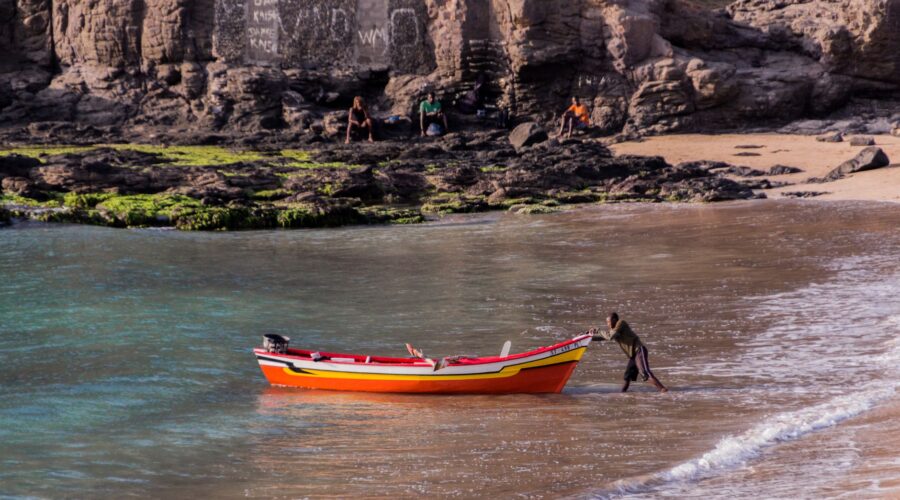
Most botes utilize a three-color palette. The primary color covers the main hull, a secondary color defines the trim, and a third, high-contrast color is used for the geometric accents. This visual clarity is essential for identification at sea; from miles away, a fisherman’s family on the shore can identify their boat by its specific color combination and pattern.
A Spectrum of Superstition: The Meaning of Colors
In Mindelo, the choice of paint is never accidental. Each color carries a weight of meaning, often rooted in a mix of Catholic tradition and West African spiritualism. The painters and fishermen believe that the right color combination can appease the sea and guarantee a bountiful catch (fartura).
- Blue and White: These are the most prevalent colors. Blue represents the sea and the sky, symbolizing harmony. White is often associated with peace and the protection of the Virgin Mary, the patroness of many seafaring communities.
- Yellow and Orange: These vibrant hues are used to ensure visibility, but they also symbolize the sun and wealth. A boat with bright yellow accents is thought to attract the “gold” of the sea—tuna and wahoo.
- Red: While visually striking, red is used sparingly. It is a color of power and blood. Some fishermen believe it wards off evil spirits (the mau olhado or evil eye), while others avoid it, fearing it might provoke the “anger” of the ocean.
- Green: Symbolizing hope and the lush valleys of the neighboring island of Santo Antão, green is a popular choice for those who want to ensure a safe return to land.
One of the most fascinating superstitions involves the “naming” of the boat. The name is usually painted in stylized, bold lettering on the side. It is considered catastrophic bad luck to change the name of a bote once it has been christened, and the painters take great care to ensure the name is legible even when the boat is pitching in the waves.
The Master Painters: A Dying Breed?
Despite the cultural importance of the botes, the art of traditional boat painting faces challenges. The rise of fiberglass hulls, which are easier to maintain and cheaper to produce, threatens the wooden boat industry. Fiberglass boats are often monochromatic, lacking the intricate hand-painted soul of their wooden predecessors.
However, in neighborhoods like Font Filipe and near the Ribeira Bote district, the tradition persists. Younger artists are beginning to see the bote patterns as a source of national pride. These geometric motifs have started appearing in contemporary Cape Verdean fashion, street art, and even high-end interior design, signaling a transition from functional maritime art to a broader symbol of “Caboverdianidade” (Cape Verdean identity).
A Tourist’s Guide to Seeing the Botes
For those visiting Mindelo, the best place to witness this art is at the Praia de Bote, located right next to the Mercado de Peixe (Fish Market). Early in the morning, as the catch is brought in, the beach is lined with dozens of these colorful vessels. If you are lucky, you might spot a painter at work, crouched under a hull with a small tin of enamel paint, carefully restoring a diamond pattern that has been weathered by the salt air.
Conclusion: The Soul of the Harbor
The bote painters of Mindelo are more than just decorators; they are the keepers of a visual diary that chronicles Cape Verde’s relationship with the Atlantic. Their work transforms a simple utility into a vessel of culture, history, and faith. As long as the wooden boats of São Vicente continue to set sail, these geometric patterns and superstitious colors will remain the vibrant heartbeat of Mindelo’s harbor, a reminder that even in the face of modernity, tradition can still float.
When you next find yourself in Mindelo, take a moment to look closely at the bow of a bote. Beyond the bright paint and sharp lines, you are looking at centuries of survival, a dash of magic, and the undeniable artistry of the Cape Verdean spirit.
Image: Pexels – Thomas Schwaak