Cape Verde Geology: The Soda-Alkaline Petrographic Province
Among the rolling waves of the central Atlantic Ocean, the archipelago of Cape Verde (Cabo Verde) stands as a geological marvel. While most travelers are drawn to its vibrant Creole culture, soulful Morna music, and white sandy beaches, geologists see the islands as a rare window into the Earth’s interior. Defining the archipelago’s physical identity is its status as a Soda-Alkaline Petrographic Province—a scientific designation that explains the unique, chemically distinct igneous rocks that form the very foundation of these ten volcanic islands.
The Foundations of an Archipelago: Volcanism and Time
The story of Cape Verde’s rocks began approximately 40 to 50 million years ago during the Eocene epoch. Unlike many islands that are formed at the edges of tectonic plates, Cape Verde sits on the “Cape Verde Rise,” a massive bathymetric swell that is one of the largest protuberances in the world’s oceans. This rise elevates a semi-circular region of the seafloor by over 2 kilometers, creating a stage for the volcanic activity that would eventually breach the ocean surface.
The islands themselves are primarily composed of igneous rocks, resulting from the cooling and solidification of molten magma. However, it is the specific chemistry of this magma that sets Cape Verde apart. The archipelago is characterized as a soda-alkaline petrographic province, meaning its rocks are unusually rich in “alkali” elements—specifically sodium (soda) and potassium—compared to the more common basaltic rocks found on the ocean floor.
What is a Soda-Alkaline Petrographic Province?
To understand the “Soda-Alkaline” label, one must look at the mineralogical “recipe” of the islands. In most oceanic settings, such as the Mid-Atlantic Ridge, volcanic rocks are “sub-alkaline,” meaning they have a lower concentration of alkali metals. Cape Verde, along with other Macaronesian neighbors like the Canary Islands and the Azores, follows a different evolutionary path.
Key Characteristics of Cape Verdean Igneous Rocks:
- Alkali Enrichment: The rocks contain high levels of sodium (Na) and potassium (K). This chemistry often leads to the formation of rare minerals that are not found in standard basalt.
- Basic Composition: The volcanic and plutonic rocks are distinctly “basic,” meaning they have a relatively low silica content.
- Petrologic Succession: Geologists have identified a specific sequence of rock types that appear as the islands age, ranging from primitive ocean-floor lavas to more evolved alkaline structures.
This unique composition is attributed to a “hotspot”—a plume of intense heat rising from deep within the Earth’s mantle. As this plume melts the overlying plate, the specific pressure and temperature conditions favor the creation of alkaline magmas.
Geological Diversity Across the Islands
Because the islands did not all form at once, Cape Verde offers a chronological “map” of volcanic evolution. Magnetic anomalies indicate that the structures under the islands date back 125 to 150 million years, but the exposed rocks tell a more recent story. The islands range in “surface age” from 20 million years in the east (Sal and Boa Vista) to about 8 million years in the west (Brava and Santo Antão).
The Oldest Secrets: Maio and Santiago
The oldest exposed rocks in the archipelago are found on the island of Maio and the northern peninsula of Santiago. These are 128-to-131-million-year-old “pillow lavas”—rounded, tube-like formations created when lava erupts directly into the cold depths of the ocean. These ancient rocks provide a rare glimpse into the early Mesozoic Era, long before the first Portuguese explorers arrived in 1456.
Living Geology: Fogo and the Active Margin
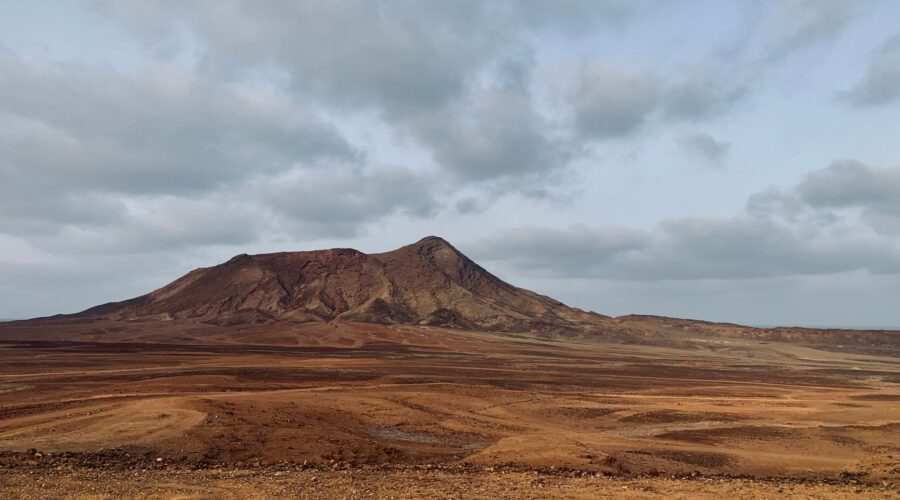
While islands like Sal and Maio have become flat and sandy due to millions of years of erosion, the island of Fogo remains a testament to the archipelago’s ongoing volcanic life. Pico do Fogo, the largest active volcano in the region, is the centerpiece of this petrographic province. Its 2014 eruption served as a reminder that the soda-alkaline engines deep beneath the islands are still firing.
The Fogo caldera, spanning eight kilometers in diameter, was formed by subsidence—a process where the ground collapses into a partially emptied magma chamber roughly 8 kilometers below the surface. The resulting landscape is a stark, monochromatic world of black volcanic glass and ash, representing the newest additions to Cape Verde’s soda-alkaline catalog.
The Practical Impact of Geology on Cape Verdean Life
The unique rock composition of the islands does more than interest scientists; it dictates the reality of the 530,000 people who live there. The “basic” nature of the igneous rocks contributes to the soil types found in the mountains of Santiago and Santo Antão. When these rocks weather in the presence of moisture, they can create fertile ground for agriculture, supporting sugarcane fields and banana plantations despite the archipelago’s overall arid climate.
Furthermore, the steep topography created by volcanic activity allows for “orographically induced precipitation.” As humid Atlantic air hits the towering mountains of the western islands, it condenses, creating microclimates that foster lush green valleys and “laurel forests.” This stands in sharp contrast to the flat, desert-like landscapes of Sal and Boa Vista, where the volcanic peaks have long since eroded away.
Conclusion: A Monument to Earth’s Interior
Cape Verde is a nation defined by its resilience—historically, politically, and geologically. From its discovery by navigators like António de Noli and its eventual independence in 1975, the country has navigated a complex path. Beneath this human history lies a deeper, 50-million-year story written in stone.
As a Soda-Alkaline Petrographic Province, Cape Verde serves as a natural laboratory. Its stones tell of deep-mantle plumes, ancient ocean floors, and the chemical signatures of a world hidden beneath the crust. For the curious traveler or the dedicated scientist, the rocks of Cabo Verde remind us that these “Green Cape” islands are not just dots in the Atlantic, but the enduring peaks of a vast and vibrant volcanic heart.
Image: Pexels – Bibi Kiekens