
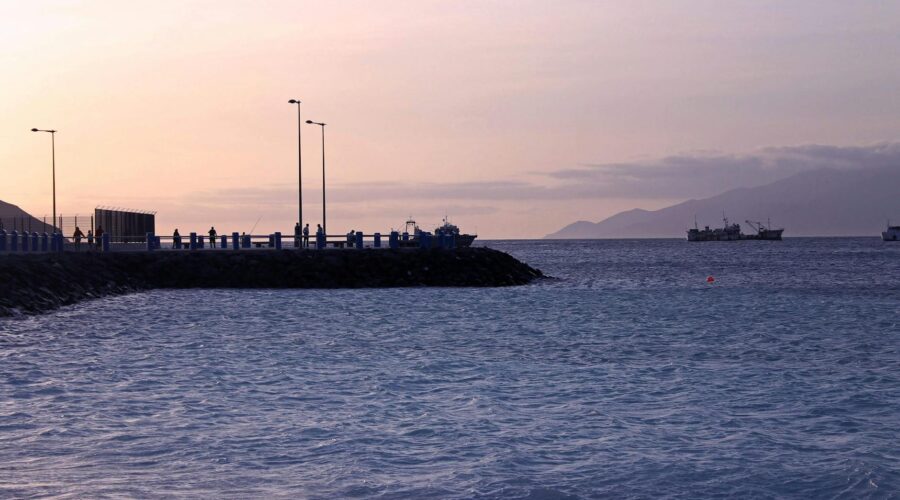
Swimming the Canal de São Vicente: A Cape Verdean Tradition
As the sun rises over the jagged peaks of Mindelo, a small group of swimmers stands on the shores of Porto Grande Bay. Before them stretches the Canal de São Vicente, a nine-mile (roughly 14 to 16 kilometers) expanse of deep Atlantic blue that separates the islands of São Vicente and Santo Antão. To the uninitiated, this stretch of water is a treacherous maritime highway known for its powerful currents and unpredictable swells. To the local “tubarões” (sharks)—the nickname given to Cape Verde’s elite open-water swimmers—it is the ultimate proving ground.
The tradition of swimming the Canal is more than just an athletic feat; it is a profound cultural statement. In a nation where the sea has historically represented both a barrier and a bridge, crossing the channel on one’s own power is an act of courage that echoes the resilience of the Cape Verdean people. Today, what began as a survival necessity or a dare among fishermen has evolved into one of the most prestigious sporting traditions in the archipelago.
The Geography of the Canal: A Formidable Opponent
Understanding the “Canal de São Vicente” begins with its geography. The channel is one of the deepest and most volatile in the Cape Verdean islands. Because the islands are of volcanic origin, the ocean floor drops off precipitously, creating complex underwater canyons that funnel the “Northeast Trades”—the prevailing winds that sweep across the Atlantic.
The distance between the city of Mindelo (São Vicente) and the port of Porto Novo (Santo Antão) is approximately 9 nautical miles. However, a swimmer never travels in a straight line. The powerful “Canal Currents” generally flow from north to south, threatening to push swimmers out into the open ocean if they do not calculate their trajectory perfectly. The water temperature fluctuates between 21°C and 26°C, which, while warm compared to the North Atlantic, can still lead to hypothermia during a crossing that typically lasts between five and eight hours.
A History Forged in Saltwater
For centuries, the relationship between São Vicente and Santo Antão was strictly one of maritime necessity. Santo Antão, the “Green Island,” provided the agricultural produce that sustained the arid port city of Mindelo. Ferries have traversed these waters for generations, moving everything from sugarcane and grogue to livestock and commuters.
The history of swimming the channel is rooted in the early 20th century. Local legends speak of sailors who fell overboard or fishermen whose boats succumbed to the waves, forced to swim miles to reach the shore. However, the transition from survival to sport began to solidify in the mid-1900s. It was often the “homens do mar” (men of the sea)—divers and boatmen—who first challenged each other to see who could conquer the distance.
In recent decades, this informal tradition has been formalized. Names like Aníbal Delgado and other local legends are etched into the community’s memory for their record-breaking crossings. These pioneers paved the way for the “Travessia do Canal,” turning a private test of will into a public celebration of Cape Verdean athleticism.
The Rise of the ‘Association of Open Water Swimmers’
To ensure safety and preserve the tradition, local swimming associations in Mindelo have worked to organize these crossings. They provide support boats, medical oversight, and navigation assistance—essential components given that the channel is a busy shipping lane for international tankers and the daily inter-island ferries like the Chiquinho BL.
The Physical and Mental Challenge
Crossing the Canal de São Vicente is 30% physical and 70% mental. Swimmers face a variety of psychological hurdles:
- The “Blue Depth”: The water is exceptionally clear, but once you leave the coast, the bottom disappears into a boundless sapphire abyss, which can cause vertigo in inexperienced swimmers.
- Marine Life: While shark attacks are virtually unheard of in the channel, the presence of large pelagic life, jellyfish, and flying fish keeps the mind racing.
- The “Middle Wash”: Roughly halfway through the crossing, the wind and waves from the open Alantic hit the swimmers hardest. This is where most attempts are won or lost.
For the swimmers of Mindelo, the training is grueling. Many utilize the “Laginha” beach as their home base, swimming laps for hours under the scorching sun to build the muscular endurance required to fight the channel’s currents. Diet, hydration, and “greasing up” with lanolin or petroleum jelly to prevent chafing and heat loss are all part of the ritual.
Cultural Significance: Morabeza and Resilience
In Cape Verdean culture, the sea is often associated with “Saudade”—a deep longing or nostalgia. It is the path taken by the millions of Cape Verdeans who emigrated in search of a better life. By swimming the channel, athletes are, in a sense, reclaiming the sea. They are proving that the water does not just take people away; it is an element that can be mastered and embraced.
When a swimmer arrives at the beach in Porto Novo, Santo Antão, they are often met by a cheering crowd. This celebration is a display of Morabeza—the famous Cape Verdean hospitality. The achievement belongs to the whole community, symbolizing the connection between the two “sister islands.”
Practical Information for Aspiring Crossers
If you are an international open-water swimmer looking to tackle the Canal de São Vicente, there are several things you need to know:
Best Time to Swim
The window for a successful crossing is usually between September and November. During these months, the “Brizas” (strong winds) tend to die down, and the sea is at its calmest and warmest. Attempting the crossing during the winter months (January–March) is extremely dangerous due to the “Brassa” (dust from the Sahara) and high swells.
Logistics and Permits
One does not simply jump into the water. You must coordinate with the Maritime Authorities (IMP – Instituto Marítimo Portuário) to ensure that your crossing doesn’t interfere with the ferry schedules. Hiring a professional support boat with a local captain who understands the currents is non-negotiable. Local swimming clubs in Mindelo are the best point of contact for organizing a sanctioned attempt.
The Route
The most common route is from the Lighthouse of Fontaínhas in São Vicente to the Port of Porto Novo in Santo Antão. Depending on the current, you may actually swim closer to 18 kilometers to offset the drift.
Looking to the Future
As sports tourism grows in Cape Verde, the Canal de São Vicente is gaining international recognition. There is potential for the “Travessia” to become a world-class marathon swimming event, similar to the Strait of Gibraltar or the English Channel crossings. Local advocates hope that further investment in swimming infrastructure will allow more young Cape Verdeans to take up the sport, ensuring that the tradition of the “Tubarões” lives on for another century.
The Canal de São Vicente remains a place of mystery and majesty. For those who have crossed it, the reward is not just a record or a medal, but a lifelong bond with the Atlantic. As they say in Mindelo, “O mar é a nossa terra”—the sea is our land. Through the tradition of the channel crossing, that land is conquered one stroke at a time.
Image: Pexels – Ana Marta Jorge