Cape Verde’s Blue Economy: Sustainable Fishing & Conservation
Stretching across the central Atlantic Ocean, the archipelago of Cape Verde (Cabo Verde) is defined by its relationship with the water. With a landmass of only 4,033 square kilometers but an Exclusive Economic Zone (EEZ) spanning approximately 800,000 square kilometres, the nation is more “ocean” than “land.” In fact, Cape Verde is a “Great Ocean State,” where the sea represents 99% of its territory.
For decades, this vast expanse was viewed primarily through the lens of traditional artisanal fishing. However, as the global climate changes and overfishing threatens Atlantic biodiversity, Cape Verde is pioneering a transformative shift. By embracing the “Blue Economy,” the nation is positioning itself as a global laboratory for deep-sea fishing sustainability, marine conservation, and blue technology.
The Pillars of the Blue Economy in Cape Verde
The “Blue Economy” is an economic model that seeks to promote economic growth, social inclusion, and the preservation of livelihoods while simultaneously ensuring the environmental sustainability of the oceans and coastal areas. For Cape Verde, this is not a luxury—it is a survival strategy.
The government’s “Blue Economy Strategic Framework” focuses on several key areas: sustainable fisheries, maritime transport, renewable energy (wave and wind energy), and marine biotechnology. However, the most urgent and complex frontier is the management of its deep-sea resources.
Sustainable Deep-Sea Fishing: A Delicate Balance
Deep-sea fishing in the Atlantic comes with immense challenges. Unlike the shallower waters near the coast, the deep sea is home to slow-growing, long-lived species that are incredibly vulnerable to overexploitation. Cape Verde is currently mapping its underwater mountains—seamounts—which are biological hotspots for tuna, swordfish, and various species of shark.
To ensure these stocks remain healthy for future generations, Cape Verde has implemented several innovative measures:
- Digital Monitoring and Surveillance: Using satellite technology and Vessel Monitoring Systems (VMS), the authorities can now track industrial fishing fleets in real-time, helping to combat Illegal, Unreported, and Unregulated (IUU) fishing.
- Selective Gear Incentives: The government is encouraging the use of “pole and line” fishing, particularly for tuna. This method significantly reduces “bycatch” (the accidental capture of non-target species like turtles or dolphins) compared to large-scale industrial netting.
- Fisheries Management Plans: Cape Verde has established strict quotas and seasonal bans on certain species, particularly the spiny lobster and various types of tuna, to allow populations to regenerate.
Marine Conservation: Protecting the “Blue Biodiversity”
Sustainability cannot exist without conservation. Cape Verde is a critical nesting ground for the loggerhead sea turtle (Caretta caretta) and a vital migratory corridor for humpback whales. The protection of these species is intrinsically linked to the health of the local economy, particularly the growing eco-tourism sector.
Expanding Marine Protected Areas (MPAs)
One of the most ambitious goals of the Cape Verdean government is the expansion of Marine Protected Areas. By designating specific zones as no-take areas or restricted-use zones, the archipelago allows ecosystems to recover. The island of Sal and Boa Vista have become international benchmarks for turtle conservation, where local NGOs like Projecto Biodiversidade and SOS Tartarugas work alongside the government to patrol beaches and monitor nests.
The Role of Seamounts
Recent scientific expeditions, often conducted in partnership with international oceanographic institutes from Germany and Portugal, have focused on the “Cape Verde Rise.” These underwater mountains act as magnets for marine life. Protecting the waters above these seamounts ensures that the “seed bank” of the ocean remains intact, providing larvae and juvenile fish that eventually migrate to the artisanal fishing grounds used by local communities.
Technology and Innovation: The Ocean Science Centre Mindelo (OSCM)
Cape Verde is not just following international trends; it is actively contributing to ocean science. The Ocean Science Centre Mindelo (OSCM), located on the island of São Vicente, is a state-of-the-art facility that serves as a hub for Atlantic research.
The OSCM allows scientists to study carbon cycles, ocean acidification, and deep-sea ecosystems. By hosting international researchers, Cape Verde ensures it has a seat at the table when global maritime policies are discussed. This scientific “soft power” enables the country to advocate for fair shark conservation laws and more equitable fishing agreements with larger entities like the European Union.
Challenges on the Horizon
Despite the progress, the road to a fully sustainable Blue Economy is fraught with obstacles. Climate change is causing the acidification and warming of the Atlantic, which alters the migratory patterns of fish stocks. Furthermore, Cape Verde faces the constant challenge of “Sea Blindness”—the difficulty of policing such a vast maritime territory with limited naval resources.
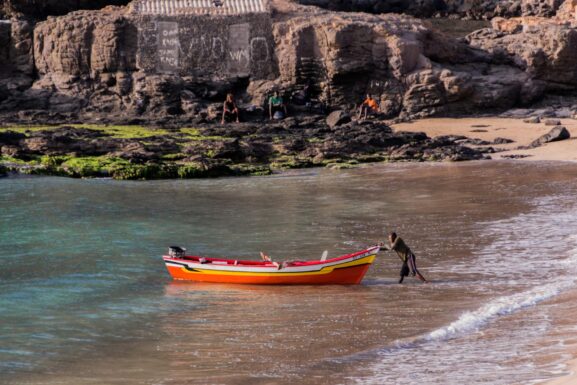
There is also the socio-economic challenge of transitioning artisanal fishermen into more sustainable practices. For many communities in islands like Santiago or Brava, fishing is not just an industry; it is a way of life that hasn’t changed in centuries. Providing these fishermen with the tools to adapt—such as solar-powered cold storage and better market access—is crucial for the Blue Economy’s success.
The Future: A Global Model for Small Island Developing States (SIDS)
Cape Verde’s journey is being watched closely by other Small Island Developing States (SIDS) in the Caribbean and Pacific. The archipelago is proving that wealth isn’t just measured by the minerals in the ground, but by the health of the water surrounding it.
By integrating tourism, sustainable fishing, and scientific research, Cape Verde is creating a “Blue Brand.” When a traveler visits the islands today, they are increasingly likely to eat sustainably caught fish, go on a whale-watching tour led by marine biologists, and stay in hotels that contribute to beach conservation. This holistic approach ensures that the “Blue” in the Blue Economy stands for more than just the color of the water—it stands for a future of resilience, prosperity, and respect for the natural world.
Key Takeaways for the International Community:
- Cooperation is Key: Protecting the ocean requires a trans-boundary approach, involving international scientific partnerships and regional naval cooperation.
- Empower Local Communities: Sustainability initiatives only work if the people whose livelihoods depend on the sea are the primary stakeholders and beneficiaries.
- Science-Led Policy: Cape Verde’s success is built on using data from centers like the OSCM to inform legislation rather than relying on short-term economic gains.
As Cape Verde continues to map its deep-sea territories and refine its conservation strategies, it stands as a beacon of hope in the Atlantic. The transition to a Blue Economy is no longer just a plan for the future—it is the reality of the present, ensuring that the heart of the archipelago continues to beat in rhythm with the waves.
Image: Pexels – Ana Marta Jorge