
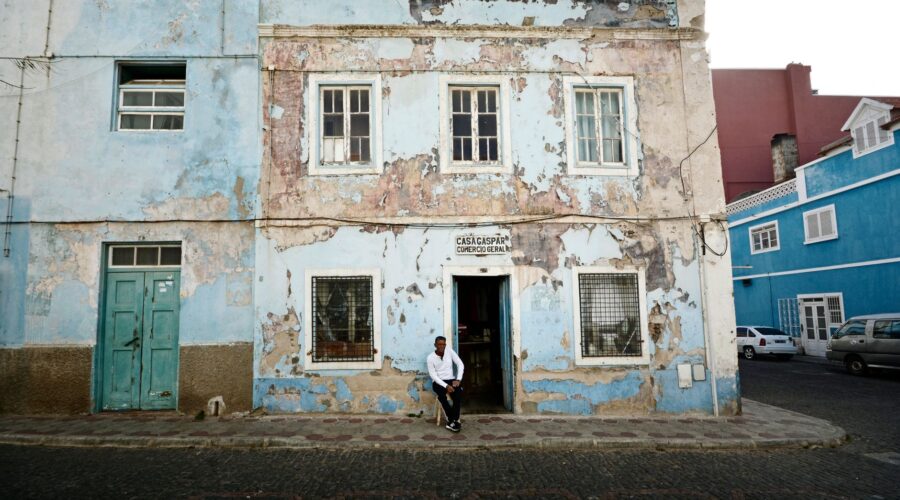
Rabenta: The Competitive Spirit of Cape Verdean Dominoes
In the vibrant port city of Mindelo, on the island of São Vicente, the rhythm of life is often dictated by the Atlantic breeze and the soulful melodies of Morna. However, beneath the architectural charm of its colonial squares and the shadow of Monte Cara, there exists a sharper, more percussive soundtrack: the thunderous clack-clack-clack of domino tiles striking wooden tables. This is not just a game; it is Rabenta, a high-stakes, high-energy cultural institution that serves as the heartbeat of Cape Verdean social life.
The Theatre of the Square: Where Rabenta Lives
Walk through Praça Estrela or the small kiosks near the fish market in Mindelo, and you will find the epicenter of this ritual. Groups of men, and occasionally women, gather around small, weathered tables. The atmosphere is electric, often thick with the aroma of strong coffee or a nearby glass of grogue. In Cape Verde, dominoes is far from the quiet, contemplative pastime associated with retirement homes in Europe or North America. Here, it is a contact sport of the mind.
The term “Rabenta” (derived from the Portuguese/Creole word for “burst” or “explode”) perfectly captures the spirit of the game. It refers to the final, decisive move—the moment a player slams their winning tile onto the table with such force it threatens to split the wood. This physical exclamation point is the climax of a psychological battle that has been brewing for twenty minutes.
Decoding the Rules and the “Social Logic”
While the basic rules of Cape Verdean dominoes follow the standard “double-six” format, the social logic governing the game is complex. In Mindelo, dominoes is almost always played in pairs. This introduces a layer of unspoken communication—a dance of intuition between partners that can take years to master.
The Art of the “Mão” (Hand)
Each player starts with seven tiles. The objective is to empty your hand first or to “lock” the game so that no more moves are possible, in which case the pair with the lowest total pips wins. However, the true skill lies in “counting the table.” A master Rabenta player knows exactly which tiles are held by their opponents and their partner based on the sequence of play. To play the wrong tile isn’t just a mistake; in the social hierarchy of the square, it is a betrayal of the partnership.
Psychological Warfare and “Boca”
The game is rarely played in silence. “Boca” (mouth) is an essential component. Players use banter, feigned frustration, and coded commentary to unsettle their opponents. A player might sigh loudly when they have a perfect hand, or confidently announce a move to bait an opponent into playing a specific number. This verbal sparring is a test of character—a way to prove one’s mental fortitude in the face of pressure.
Rabenta as a Reflection of Mindelense Identity
To understand Rabenta is to understand the soul of Mindelo. The city has always been a crossroads—a port town where sailors, merchants, and artists from across the Lusophone world converged. This history has fostered a culture that prizes wit, social intelligence, and the ability to read people.
The domino table is a great equalizer. In the public squares, a retired civil servant, a dockworker, and a young musician might sit at the same table. For the duration of the match, their social status outside the square is irrelevant. The only thing that matters is their ability to “read the table” and execute the Rabenta.
The Competitive Spirit: Tournaments and Prestige
While the daily games in the squares are informal, the competitive spirit is fierce. There is a deep-seated prestige associated with being a “Champion of the Square.” In Mindelo, reputations are built over decades. A player known for a “heavy hand” (one who wins consistently with powerful finishes) earns a level of respect that transcends the game.
In recent years, there has been a push to formalize these competitions. Local associations in São Vicente organize tournaments that draw crowds, complete with spectators who provide their own running commentary, often just as loud as the players themselves. These events are not just about the prize money; they are about defending the honor of one’s neighborhood or “zona.”
Practical Tips for the Curious Traveler
If you find yourself in Mindelo and wish to witness this spectacle, here is what you need to know:
- Observation first: Never ask to join a game immediately. Stand back, watch a few rounds, and appreciate the rhythm. The regulars will notice your interest.
- The Language of the Game: You will hear terms like “bucho” (having many tiles of one number) or “fechado” (a blocked game). Even if you don’t speak Cape Verdean Creole, the body language tells the story.
- Respect the Table: The tables in the squares are often decades old. They are sacred spaces. Don’t place drinks directly on the playing surface unless invited to do so.
- Sunday is Peak Time: While games happen daily, Sunday afternoons after the heat of the day has passed are when the “heavyweights” usually come out to play.
Conclusion: More Than Just a Game
In an era of digital entertainment and smartphone gaming, the Rabenta tradition of Mindelo remains stubbornly, gloriously analog. It is a testament to the Cape Verdean love for community and face-to-face interaction. The game serves as a bridge between generations, a classroom for social strategy, and a theater for the dramatic flair that defines the people of São Vicente.
When the final tile hits the table in a Mindelo square, the sound echoes through the narrow streets. It is the sound of a “Rabenta”—a small explosion of joy, competition, and cultural pride that continues to define the social logic of this Atlantic gem.
Image: Pexels – damien Saillet