Traditional Crafts of Cape Verde: A Guide to Island Artistry
Deep within the rhythmic soul of the mid-Atlantic lies Cape Verde, an archipelago where the winds of Africa meet the artistic legacies of Europe. While the islands are globally renowned for the melancholic beauty of Morna music, there is a silent, tactile symphony playing out in the workshops and homes of local artisans. Traditional Cape Verdean crafts are more than mere souvenirs; they are the physical manifestation of “Morabeza”—the spirit of hospitality and resilience that defines these ten volcanic islands.
The Geometric Soul: Pano de Terra
Perhaps the most iconic symbol of Cape Verdean identity is the Pano de Terra (cloth of the land). This hand-woven textile is a masterclass in geometric storytelling. Historically, the production of these narrow strips of cotton cloth was centered on the island of Santiago, particularly in the town of Tarrafal.
The weaving process is labor-intensive, performed on a traditional horizontal loom known as the tear de pedal. The distinctive patterns, usually in indigo and white, are created using a complex supplementary-weft technique. Historically, these cloths were so highly valued that they served as a form of currency during the transatlantic trade era. Today, the Pano de Terra is worn with pride during cultural festivals, used as a ceremonial shawl for women (often used to carry babies on their backs), and gifted as a symbol of prestige.
Symbolism in the Threads
Each pattern in a Pano de Terra has a specific meaning. The “Lelê” pattern, for instance, is one of the most traditional, representing the interconnectedness of the community. Owning a genuine Pano de Terra is considered a rite of passage, a piece of heritage that links modern Cape Verdeans to their West African Mandinka and Fula roots.
The Earth in Their Hands: Ceramics and Pottery
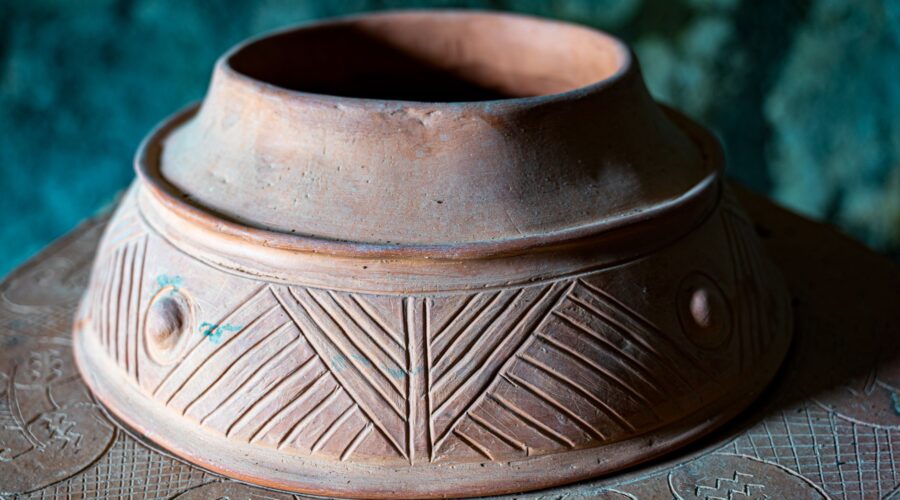
In the arid landscapes of Boa Vista and the green valleys of Santiago, the earth itself provides the medium for artistic expression. Cape Verdean pottery is characterized by its raw, unglazed beauty and functional design.
In the village of Fonte Lima on Santiago, the “Olaria” (pottery) tradition remains a female-dominated craft. Artisans do not use a modern potter’s wheel; instead, they use a traditional method of building clay coils by hand, smoothing them with stones or shells. The pieces are then fired in open pits using dried cow dung or wood as fuel. The result is a range of earthy, terracotta-colored vessels—pots for storing water, bowls for serving Cachupa (the national stew), and the famous buli (a traditional water jug).
On the island of Boa Vista, the pottery style takes on a different aesthetic, often featuring more decorative elements, reflecting the island’s unique history as a hub for clay production since the 15th century.
Basketry: Art Born of Utility
The art of basket weaving in Cape Verde is a testament to the archipelago’s resourcefulness. Using raw materials such as sisal, palm fronds, and wicker, artisans create intricate containers that are as durable as they are beautiful.
On the islands of Santo Antão and São Nicolau, where the terrain is rugged and agriculture is the heartbeat of life, basketry is essential. You will find the balaio—a wide, flat basket used for winnowing grain or carrying fruit on the head. The technique involves a tight coil or twill weave, often incorporating natural dyes to create subtle patterns. These baskets are not just tools; they are a bridge to a time when every object in a household had to be crafted by hand from the surrounding landscape.
Coconut Shell and Horn: The Art of Upcycling
Long before “upcycling” became a global trend, Cape Verdean artisans were transforming natural waste into wearable art. The use of coconut shells and cow horn is particularly prevalent in the markets of Mindelo on the island of São Vicente.
Skilled craftsmen carve, sand, and polish coconut shells to create intricate jewelry, buttons, and decorative bowls. Similarly, cow horn is transformed into gleaming, translucent combs, earrings, and necklaces. These crafts highlight the Cape Verdean philosophy of “fala pouco, faz muito” (speak little, do much)—the ability to find value and beauty in the simplest of materials.
The Luthier’s Touch: Crafting the Sound of the Islands
Music is the lifeblood of Cape Verde, and the instruments that produce it are works of art in their own right. The Cavaquinho (a small four-stringed guitar) and the 12-string guitar are staples of the local soundscape. In Mindelo, known as the cultural capital, master luthiers still hand-build these instruments.
Constructing a Cavaquinho requires a deep understanding of acoustics and wood types, often using local mahogany or imported pine. A handcrafted instrument from a Cape Verdean workshop is prized by musicians worldwide for its bright, percussive resonance, which is essential for playing genres like Coladeira and Funaná.
Where to Find and Support Traditional Crafts
For travelers looking to experience these crafts firsthand, there are several key locations to visit:
- Centro Nacional de Artesanato e Design (CNAD) in Mindelo: This is the premier institution for the preservation of Cape Verdean art. Located in a stunning modern building, it hosts exhibitions and workshops focused on weaving and contemporary design.
- Associação Vida no Estaleiro (Santiago): A great place to see Pano de Terra weaving in action.
- Mercado Municipal (Praia or Mindelo): These bustling markets are the best places to find everyday basketry and pottery directly from the makers.
Preserving the Heritage
As the archipelago modernizes, there is a growing movement to ensure these traditional crafts do not disappear. Government initiatives and local cooperatives are working to train younger generations in the art of the loom and the kiln. By purchasing authentic Cape Verdean crafts, visitors are not just buying a gift; they are providing the economic support necessary to keep these ancient techniques alive.
The traditional crafts of Cape Verde are a window into the islands’ history of migration, survival, and creative triumph. Whether it is a hand-woven textile or a clay pot, each piece carries the warmth of the sun and the rhythm of the Atlantic, offering a tangible connection to the heart of Cabo Verde.
Image: Pexels – William ZALI